The designer Virgil Abloh at the Off-White show at Paris Fashion Week earlier this month. (Credit Francois Durand/Getty Images) by VANESSA FRIEDMAN and ELIZABETH PATON via nytimes.com Virgil Abloh, the founder of the haute street wear label Off-White and a longtime creative director for Kanye West, will be the next artistic director of men’s wear at Louis Vuitton, one of the oldest and most powerful European houses in the luxury business. He becomes Louis Vuitton’s first African-American artistic director, and one of the few black designers at the top of a French heritage house. Olivier Rousteing is the creative director of Balmain, and Ozwald Boateng, from Britain, was the designer for Givenchy men’s wear from 2003 to 2007.
“I feel elated,” Mr. Abloh said via phone on Sunday, adding that he planned to relocate his family to Paris to take the job at the largest brand in the stable of LVMH Moët Hennessy Louis Vuitton, the world’s largest luxury group. “This opportunity to think through what the next chapter of design and luxury will mean at a brand that represents the pinnacle of luxury was always a goal in my wildest dreams. And to show a younger generation that there is no one way anyone in this kind of position has to look is a fantastically modern spirit in which to start.”
The appointment, widely rumored in recent months, is part of a shake-up on the men’s wear side of LVMH, which began in January with the departure of Kim Jones, Mr. Abloh’s predecessor at Louis Vuitton. Last week, it was announced that Mr. Jones would become the men’s wear designer at LVMH stablemate Christian Dior, replacing Kris van Assche.
Mr. Abloh’s appointment is also a reflection of the increasing consumer-driven intermingling of the luxury and street wear sectors, which helped boost global sales of luxury personal goods by 5 percent last year to an estimated 263 billion euros (about $325 billion in today’s dollars), according to a recent study by the global consulting firm Bain & Company. And it is an acknowledgment on the part of the luxury industry that it must respond to contemporary culture in new ways.
Author Jacqueline Woodson (Juna F. Nagle / HarperCollins) by Lori Lakin Hutcherson (@lakinhutcherson)
According to latimes.com, acclaimed author Jacqueline Woodson, who won a National Book Award for “Brown Girl Dreaming,” just won the 2018 Astrid Lindgren Memorial Award on Tuesday. The award comes with a prize of $608,000, which is funded by the government of Sweden. Publishers Weekly reports that Woodson is the 18th person or organization to win the prize, which is considered one of the most prestigious children’s literary awards in the world.
The Lindgren Award, named after the Swedish creator of “Pippi Longstocking,” caps a list of many honors Woodson has won over her career. In addition to her National Book Award, the author has won the Coretta Scott King Award twice and a Newbery Award four times.
In January, the Library of Congress named Woodson the National Ambassador for Young People’s Literature. Although Woodson has written two adult novels, “Autobiography of a Family Photo” and “Another Brooklyn,” most of her published work has been for middle-grade readers and young adults.
Recently, Good Black News was invited to cover the launch of “One Strange Rock,” a ten-part space/science series on the National Geographic Channel that premieres Monday, 3/26, and is hosted and narrated by Will Smith.
It is director Darren Aronofsky‘s (“Black Swan,” “mother!,” “Requiem For a Dream”) first foray into television, and the series is produced by Jane Root through her production company Nutopia. It is a cinematic look at Earth from a variety of perspectives – from space, from the sea, from the desert – and across all continents.
From the episodes I’ve seen, “One Strange Rock” is a gorgeous, meditative, eye-opening look at our planet, and Smith is a welcome, friendly guide along the journey to get to know Earth and all its ecosystems in ways we haven’t seen or previously considered. But what honestly got me excited about “One Strange Rock” was the opportunity to sit down one-on-one with Dr. Mae Jemison, the first African-American female to travel into space (and one of my personal she-ros) to speak with her about her participation in “One Strange Rock,” as well as her other current projects (100 Year Starship and Look Up).
As I start to record the interview (this is moments after I fangirl and tell Dr. Jemison I dressed up as her one Halloween, entered a costume contest and won a 25-dollar gift card to Virgin Records), I state into my Voice Memo app the date, time, and that I’m about to interview Dr. Mae Jemison, she charmingly interrupts.
Mae Jemison: How about if we do it in Star Date Time? 2018.01.13, right?
Good Black News: Way better! That’s a Trekkie for you! I appreciate that, thank you, Dr. Jemison. Well, first I want to ask you about your involvement in “One Strange Rock.” Why, of all the different entities out there covering space, space travel, space exploration, did you want to lend your voice to this project?
MJ: So “One Strange Rock” is the story of the extraordinary journey of Earth. It’s about our home planet and how we went from this collection of rock and gases to something that supports life and an incredible diversity of life, and I wanted to be a part of that. When people think about space, so frequently they think about it just as the stars and the pictures and images and the rockets. But actually, space allows us to see our world that we live on. Space allows us to understand that when we look up at the stars, we’re actually made of the stuff of stars. Right? Inside of us is the heart of an old star. Doesn’t that make you feel like you belong to this universe and that you’re supposed to be here?
Absolutely. So is your hope with this particular project that more people will get that understanding that there isn’t a separation?
MJ: “One Strange Rock” does this incredible thing – it takes us from the smallest microbe, or to how oxygen is generated in small bubbles, all the way to the vistas of continents or being able to see our atmosphere, and connects it together. And so for me, one of the things we need to understand at some point in time – we’ve got to figure this out – is that we’re Earthlings and that we’re connected to this planet. So when I went into space, one of the things that happened to me is that I had an affirmation of something that I always believed. You know when people say, “Save the Earth”? They’re mistaken – the Earth will be here. The difference is, can we act in such a way that it continues to support our life form? You see, what “One Strange Rock” shows is how integrated life is on this planet and we as humans are part of that life. If we go to another world – just go to the space station – we have to carry some of the Earth with us. We have to carry that environment with us because this is where we evolved, this is where we developed. That doesn’t mean we shouldn’t leave – obviously I want to leave -I want to go and explore other places. But it’s the recognition that there are a… unique series of coincidences, events and everything that led us to this day, to humans, to me sitting talking to you. And they started billions of years ago.
So with all of that, you talk in the first episode about the “Overview Effect” – about seeing the planet and essentially what you just communicated to me. How do you get people who don’t have the opportunity to go into space to understand that boundaries and countries and all of these things that we do as human beings to identify in all these different ways is a way of looking at Earth that isn’t going to help foster the survival of our species?
MJ: So I want to make one thing clear – I know a lot of astronauts talk about the “Overview Effect” – that everything belongs right here on this planet – for me when I went into space… I knew damn well that water crosses from one country to another, that our sky is over different countries and weather affects everyone. What “One Strange Rock” does is help people to understand and feel that. So I can maybe mumble words and give you statistics and stuff, but it’s not the same thing as having that emotional connection. What I’m so proud about with “One Strange Rock” is that it takes images from lots of different countries, from African countries, from South American countries – it goes down underneath the Earth and goes up to the top. And all those things help us to see this planet and the imagery from people, to animals, to… desolate locations. And so, it’s not so much again about mumbling the words, or even saying the words very clearly, it’s about allowing people to see and be there with you. And not just from space, because we get down to the detail. We see kids playing, we see folks who’ve been collecting salt for generations from one location. All of those things are important for us to understand our connectedness to this world. And it’s not about preaching and it’s not about how fast the Space Station is orbiting the Earth or any of that kind of stuff – it’s that vantage point.
Paula Mae Weekes (photo via twitter.com) by Tiffany McGee via thegrio.com
For the first time, the twin island Caribbean nation of Trinidad and Tobago has a woman president. After an electoral college win in January, Paula Mae Weekes, a retired Court of Appeal judge was sworn in on Monday, Latin American network TeleSUR reported. Weekes’ inauguration makes Trinidad the only nation in the region to have a woman as head of state after Chile’s Michelle Bachelet vacated her position on March 11.
Obstacles still remain
Despite making history, Weekes is taking office at a challenging time for the nation, known best for its Carnival and for robust oil and natural gas exports. She replaces Anthony Carmona who leaves behind an extremely high murder rate — nearly 400 people in Trinidad have been victims of homicide in in 2017, according to the Trinidad Guardian. She’ll also have to take on an increasing unemployment rate, which rose to 5.3 percent in the second quarter of 2017, Trading Economics reported.
In her inaugural speech, she pledged to take on these and other problems head on. “None of us is blind or foolish enough to deny that Trinidad and Tobago is going through dark times, but I echo the words of C.S. Lewis when I say: ‘this a good world gone wrong but it still retains the memory of what ought to have been’.”
Weekes, 59, worked in both the public and private sectors after graduating law school. Beginning in 1982 she worked in the Office of the Director of Public Prosecutions for 11 years before going into private practice. In 1996, she became a judge at the Criminal Division of Trinidad’s High Court, and in 2005 she was promoted to the Court of Appeal. She also served as Justice of Appeal in Turks and Caicos for three years. She was also Chancellor of the Anglican Church, where she oversaw all finances. To read more: https://thegrio.com/2018/03/20/paula-mae-weekes-trinidad-inauguration/
Danai Gurira, Florence Kasumba “Black Panther”(Photo by Marvel/Disney/Kobal/REX/Shutterstock) by Lori Lakin Hutcherson (@lakinhutcherson) “Black Panther” continues to dominate the North-American box office for the fourth weekend in a row, earning $41.1 million , according to Variety.com. In second place is the Ava DuVernay‘s family-friendly fantasy adventure “A Wrinkle in Time” with $33.5 million, not only giving Disney the two top movies for the weekend, but the first weekend in box office history where the top two movies are directed by African-Americans.
With $562 million in 24 days, “Black Panther” is now the seventh-highest domestic grosser of all time. It’s the first film since “Star Wars: The Force Awakens” to lead the North American box office for four straight weekends and it’s grossed $1.08 billion worldwide, 21st highest of all time. The Ryan Coogler tentpole is the 33rd movie to gross $1 billion. It’s the 16th Disney film to reach this milestone, and the fifth Marvel film to do so — joining the ranks of “The Avengers,” “Avengers: Age of Ultron,” “Iron Man 3,” and “Captain America: Civil War.”
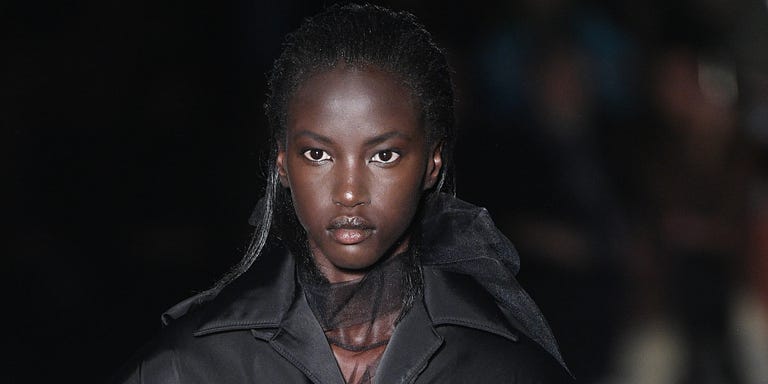
Model Anok Yai (Getty Images) by Lauren Alexis Fisher via harpersbazaar.com
Last week, model Anok Yai made history at Prada‘s Fall 2018 show during Milan Fashion Week.
The 19-year-old became the second black model to ever open a Prada show. The first was Naomi Campbell back in 1997. Yes, it’s been over two decades since a woman of color opened a Prada runway.
Anok took to Instagram to thank Miuccia Prada, along with her team, for the opportunity, writing, “Can’t believe I’m the first black woman to open for Prada since queen @iamnaomicampbell, forever grateful.”
The model’s monumental runway walk is especially incredible as she was just discovered last fall while attending Howard University’s homecoming. Weeks later, she signed with Next Models. And just one month ago, she made her runway debut at Prada’s Menswear Fall 2018 show.
Of course, the fact that Prada hasn’t cast a woman of color to open its show in over two decades is problematic in itself. In the past, the brand has come under scrutiny for its lack of diversity both on the runway and in its campaigns. Hopefully, Anok opening the Fall 2018 show is an indication the Italian fashion house is headed in the right direction when it comes to diversity.
Extremely slowly, but surely, more and more brands are recognizing the importance of casting diverse runways. This season’s Fall 2018 shows at New York Fashion Week marked the most racially diverse of all time—with women of color accounting for 37.3% of all castings. Still, there’s a lot of work to be done.
by Dave McNary via Variety.comDisney-Marvel’s “Black Panther” is re-writing the record books, topping “Star Wars: The Last Jedi” for the second-highest four-day domestic opening of all time, with $242 million at 4,020 North American locations.The superhero pic set a record for top Monday domestic gross ever, with $40.2 million, edging the previous high set by “Star Wars: The Force Awakens” at $40.1 million. The Monday total came in $7 million above the studio’s projections and lifted the four-day haul to $242 million.
“Black Panther” has grossed the second-highest four-day total of all time, behind only “Star Wars: The Force Awakens” at $288.1 million and $400,000 ahead of “Star Wars: The Last Jedi.”
Disney also reported Tuesday that the international total has reached $184.6 million to lift the worldwide take to $426.6 million, led by South Korea at $27.1 million and the U.K. at $26.7 million.
The tentpole, starring Chadwick Boseman and directed by Ryan Coogler, has blown past its original tracking. The film, which carries an estimated $200 million production budget, had been tracking to bring in between an impressive $100 and $120 million when first projections emerged on Jan. 25.
Since then, “Black Panther” has become a must-see event as it’s veered into record-setting territory and has continued to shatter all projections since then. It has the highest three-day debut ever for a February film and the fifth-biggest of all time behind only “Star Wars: The Force Awakens” at $248 million, “Star Wars: The Last Jedi” at $220 million, “Jurassic World” at $208.8 million, and “The Avengers” at $207.4 million.
“Black Panther” has demolished the record for the largest Presidents Day weekend, blowing past “Deadpool’s” 2016 mark of $152 million. Source: http://variety.com/2018/film/news/black-panther-box-office-tops-star-wars-last-jedi-1202704917/
(images by Àsìkò, Disney/Marvel) by Ricky Riley via blavity.com
With just a few more days until its release, Marvel‘s next installment into their cinematic universe, Black Panther, has already started shaping the imaginations of a generation of kids.
London-based Nigerian photographer Àsìkò, who goes by @asiko_artist on social media, decided to highlight this by recreating the sensational character posters with kids inspired by the film. Àsìkò shared a few individual pictures from the series on Instagram and wrote about why Black Panther matters and what it means to him as comic lover.
“As a kid who read comics black panther was one of the very few superheroes I came across,” he wrote. “For a child it is a beautiful thing to see yourself represented in a positive light in pop culture. What is also great is that it’s a hero steeped in culture and heritage and not drug deals or street thugging.”
“The images are inspired by the movie character posters and will be displayed at the BFI on its opening film night this Friday evening,” he added.
Àsìkò wrote that the photos were commissioned by the Talent Agency @lookslikemeuk. On his page, he posted a series of pictures featuring young kids channeling characters from the film, along with captions that include moving letters from fans on why black representation in film matters. To read more, go to: https://blavity.com/these-awesome-kids-channelled-their-inner-black-panther-to-recreate-posters-for-the-film
Ifeozuwa Oyaniyi, 5, born in Nigeria, holds flags given to him by the U.S. Citizenship and Immigration Services while waiting to receive his citizenship certificate in New York City. (John Moore/Getty Images) by Ann M. Simmons via latimes.com
Lots of the news from sub-Saharan Africa is about war, famine, poverty or political upheaval. So it’s understandable if many Americans think most Africans who immigrate to the United States are poorly educated and desperate. That’s the impression that President Trump left with his comments to members of Congress opposing admission of immigrants from “s***hole countries” in Africa and elsewhere.
But research tells another story.
While many are refugees, large numbers are beneficiaries of the “diversity visa program” aimed at boosting immigration from underrepresented nations. And on average, African immigrants are better educated that people born in the U.S. or the immigrant population as a whole.
“It’s a population that’s very diverse in its educational, economic and English proficiency profile,” said Jeanne Batalova, a senior policy analyst at the Migration Policy Institute think tank in Washington and co-author of a report last year on sub-Saharan African immigrants in the U.S. “People came for a variety of reasons and at various times.”
Overall, their numbers are small compared with other immigrant groups but have risen significantly in recent years. The U.S. immigrant population from sub-Saharan Africa (49 countries with a total population of more than 1.1 billion) grew from 723,000 to more than 1.7 million between 2010 and 2015, according to a new report by New American Economy, a Washington-based research and advocacy group. Still, they make up just half a percent of the U.S. population.
Drawing from U.S. surveys and Census Bureau data, the report found that the majority come from five countries: Nigeria, Ghana, Kenya, Ethiopia and South Africa. The Pew Research Center reported that African immigrants are most likely to settle in the South or Northeast, and that the largest numbers — at least 100,000 — are found in Texas, New York, California, Maryland, New Jersey, Massachusetts and Virginia. Many African refugees have also relocated to or have been resettled in states such as Minnesota and South Dakota.
The Refugee Act of 1980 made it easier for people fleeing war zones to resettle in the U.S., and today there are tens of thousand of refugees from Somalia, Sudan and Congo. About 22% of African immigrants are refugees, according to Andrew Lim, associate director of research at New American Economy.
At the same time, the diversity visa program — also known as the visa lottery — has opened the door to immigrants from more peaceful places. Of the sub-Saharan immigrants who have become legal permanent residents, 17% came through the program, compared with 5% of the total U.S. immigrant population, according to Batalova.
Applicants to the program must have completed the equivalent of a U.S. high school education or have at least two years of recent experience in any number of occupations, including accountant, computer support specialist, orthodontist and dancer. As a result, the influx includes many immigrants from sub-Saharan Africa who are highly skilled professionals.
MSU African Studies Center Facebook Cover Photo (via facebook)
via newsone.com
$1.5 million grant gifted to Michigan State University by the Andrew W. Mellon Foundation will go towards the cultivation of a database that harbors information about former slaves, MSU Today reported.
The database, which is part of the institution’sEnslaved: The People of the Historic Slave Trade initiative, will encompass data surrounding those who came to America during the Atlantic slave trade; giving individuals the opportunity to explore their ancestry, the news outlet writes. Individuals who utilize the database will also be able to view maps, charts, and graphics about enslaved populations. The project is being spearheaded by Dean Rehberger, director of Matrix: The Center for Digital Humanities and Social Sciences at MSU, Walter Hawthorne, professor and chair of MSU’s Department of History and Ethan Watrall, who serves as an assistant professor of anthropology at the university.
MSU Today reports that the project will go through several phases and take nearly a year and a half to be completed.
Hawthorne believes that the database will allow scholars to delve deeper into the dark history of slavery. “By linking data compiled by some of the world’s foremost historians, it will allow scholars and the public to learn about individuals’ lives and to draw new, broad conclusions about processes that had an indelible impact on the world,” he said in a statement, according to the source. Michigan State University has one of the top African history graduate programs in the country and leaders at the institution believe that this new project will further its impact in this space. Institutions who have partnered with MSU for the project include Emory University, Vanderbilt University, Harvard University, the University of Maryland and others.
Slavery has been a common topic at colleges and universities across the country with many institutions coming forward to acknowledge and come to terms with their ties to slavery. Rutgers University recently paid tribute to former slaves by renaming parts of its campus after individuals who built the university from the ground up. Source: MSU Today




 The project is being spearheaded by Dean Rehberger, director of Matrix: The Center for Digital Humanities and Social Sciences at MSU, Walter Hawthorne, professor and chair of MSU’s Department of History and Ethan Watrall, who serves as an assistant professor of anthropology at the university.