In this day and age, 11-year olds don’t usually go to college. But it’s those who break the rules that get the most recognition.
Carson Huey-You is amazing and brilliant. The young prodigy was accepted to Texas Christian University at the age of 10, where he chose to study the difficult field of Quantum Physics. In case you’ve never heard of Quantum Physics, it is defined as: The study of the behavior of matter and energy at the molecular, atomic, nuclear, and even smaller microscopic levels.
The young student speaks Mandarin Chinese fluently, and got 1770 on his SAT. He is also a very good piano player, among other things. He was so young that he wasn’t able to actually apply to the school online. It turns out that the software would not allow applicants to state that they were born in the year 2002.
The child is expected to be a college graduate by the age of 16, which would make him a year younger than the youngest graduate the school has ever had. ‘‘I’m taking calculus, physics, history and religion. Those are my four classes,’ Huey-You told CBS DFW.

This is not the first time that young Carson showed such promise. He was reading by the age of 1 and doing pre-algebra by the age of 5, according to his parents.
“He’s definitely very talented and also he’s very serious about his work and he really enjoys it. And that’s the best that a professor can hope for his students, right?’ Associate math professor Qao Zhang said to CBS DFW.
Carson says that his first week of college was “overwhelming, but exciting and fun.”
In the spirit of family learning and growth, Carson’s mother expects to join him on campus to get education of her own. Claretta Huey-You says that she herself is planning on going back to school to study nursing. Additionally, his brother is expected to finish high school by the age of 13.
To read more, go to: risingafrica.org
Posts published in “Community”

Joshua Woods said he never believed he would attain his dreams, but that all changed when he graduated from Wichita State in December. That’s because Woods was homeless and lived on his sister’s floor.
Woods’ parents had both died and he was ready to give up. Instead, he used his last $30 to apply to Wichita State and was accepted. “I was disappointed. Mostly in myself but also at life. I felt like I wasn’t dealt a good hand to begin with. I was in foster care. My father passed away when I was 16. I was the only kid on my block with no guardian.”
He worked his way through college, which included working overnight at a grocery store. In the mornings, he would run five miles to school because he had no vehicle. “It was hard to hold my tears as I walked across that stage,” Woods said. “To be considered stupid all your life and you graduate from college with a bachelor’s degree… I don’t know about anyone else, but it was a triumph for me.”
Woods graduated with a communications degree and hopes to pursue a career in journalism.
article via fox5atlanta.com

The U.S. Navy will honor civil rights icon and Georgia congressman John Lewis in a big way — by naming a replenishment oiler ship after the leader.
The announcement — delivered by Secretary of the Navy Ray Mabus — was made Wednesday afternoon in Washington D.C. Lewis, who tweeted he was “grateful” for the honor, reportedly cried when he was informed of the idea months ago.
According to NBC:
“As the first of its class, the future USNS John Lewis will play a vital role in the mission of our Navy and Marine Corps while also forging a new path in fleet replenishment,” said Mabus. “Naming this ship after John Lewis is a fitting tribute to a man who has, from his youth, been at the forefront of progressive social and human rights movements in the U.S., directly shaping both the past and future of our nation.”
Lewis cried when Mabus stopped by his office a few months ago to share what was then an idea, he told NBCBLK. “He said, ‘I have been so moved and inspired by your work and others during the civil rights movement. My idea is to name a ship in your honor,’” Lewis said. When the surprised congressman asked him, “How can you do this,” Mabus responded, “I am the Secretary of the Navy; I have the power.”
https://twitter.com/repjohnlewis/status/684841235807354881/photo/1?ref_src=twsrc%5Etfw
Naming the ship after the civil rights leader is a first in many ways — the USNS John Lewis is said to be the “first of the next generation” of fleet replenishment oilers (T-AO-205), measuring more than 677 feet long and 97.5 feet wide. They are responsible for providing fuel and fleet cargo to ships at sea, NBC reports. The new generation of ships will all be named after Civil Rights heroes, a first also announced by Lewis’ office.
The irony of a ship donning his name is not lost on Lewis, 75, who told NBC he never actually learned to swim.
“In Troy, we couldn’t use the swimming pool, so I never learned to swim,” he said. “All these years later, to hear the Secretary of the Navy say he wanted to name a ship after me — we cried a little together and we hugged.”
I believe in freedom. I believe so much that people should be free. I was prepared to give it everything I had,” he said. “I didn’t do anything special. I just got in trouble. It was good trouble. It was necessary trouble. My parents would tell us, ‘Don’t get in the way.’ I just tried to help out.”
It is that focus on freedom that Mabus says will live within USNS John Lewis.
“T-AO 205 will, for decades to come, serve as a visible symbol of the freedoms Representative Lewis holds dear, and his example will live on in the steel of that ship and in all those who will serve aboard her, ” said Mabus.
Lewis, who is widely known for his role in the Freedom Rides of the 1960s and for serving as chairman of the Student Nonviolent Coordinating Committee (SNCC), was elected to Congress in 1986. The leader, who often demonstrated alongside Dr. Martin Luther King Jr., was also a keynote speaker at 1963’s March on Washington.
It is Lewis who, bloodied and beaten, can be seen in historic and disturbing photographs from Bloody Sunday in Selma, Alabama. State troopers beat Black activists attempting to cross the Edmund Pettus Bridge on March 7, 1965 into Montgomery. Lewis, only 24 at the time, led the march with activist Hosea Williams.
SOURCE: NBC
article by Christina Coleman via newsone.com

When Dr. Hadiyah-Nicole Green receives invitations to be a guest speaker for professional groups, schools and nonprofit organizations, she almost never turns them down.
“Usually if there is an invitation to speak at a forum like that, I accept it because I feel like it’s a responsibility,” she said. “There are so few of us (black women in STEM fields) I don’t feel like I have the luxury to say I’m too busy.”
By many measures, Green has been extremely busy. One of fewer than 100 black female physicists in the country, she recently won a $1.1 million grant to further develop her patent-pending technology for using laser-activated nanoparticles to treat cancer.
Green earned her master’s and Ph.D degrees at the University of Alabama at Birmingham, and is now is an assistant professor in the physics department at Tuskegee University.
Green’s personal history with cancer fuels her drive to find a way to treat it. She grew up in St. Louis and – after the death of her mother and father – was raised by her aunt and uncle, General Lee Smith and his wife, Ora Lee.
When Ora Lee was diagnosed with cancer, “She refused the treatment because she didn’t want to experience the side effects,” said Green. “It was heartbreaking, but I could appreciate she wanted to die on her own terms. “Three months later, my uncle was diagnosed with cancer.”
Green took time off from school to help him through chemotherapy and radiation treatments. “I saw first-hand how devastating it was, and I could understand why my aunt didn’t want to go through that.”
She earned a bachelor’s degree in physics with a concentration in fiberoptics, and then a full scholarship to UAB. She got the idea to use lasers to treat cancer without the side effects of chemo and radiation.
A physicist’s cancer treatment
A few months ago, Green was awarded a $1.1 million grant to work on a technology that targets, images and treats cancer. “I was completely overwhelmed with joy, with thanksgiving, humbled at the opportunity that a group of my peers thought that my work was worthy for such a grant,” she said. “This is a huge door opening. It outlines a path to take this treatment to clinical trial.”
The indictment marked the conclusion of the grand jury’s investigation of the case.
If convicted of the misdemeanor perjury charge, Encinia faces up to a year in jail, according to Warren Diepraam, a spokesman for the Waller County district attorney’s office. The grand jury declined to indict on a charge of aggravated perjury, Diepraam said.
Bland, 28, who was black, was found hanging by a plastic bag in her jail cell three days after she was arrested July 10 during a routine traffic stop about 55 miles west of Houston.
Encinia pulled over Bland for making an improper lane change. The confrontation that ensued, which led to Bland’s arrest on suspicion of assaulting Encinia, was captured on a dashboard camera video that went viral.
The charge against Encinia stemmed from a one-page probable cause affidavit that Encinia filed with jail officials justifying Bland’s arrest, in which he wrote that the reason he removed her from her car was to conduct a safer traffic investigation, said special prosecutor Shawn McDonald.
“The grand jury found that statement to be false,” McDonald said.
After she was arrested, Bland was taken to the Waller County Jail in nearby Hempstead, where she was unable to make $500 bail. Officials said Bland hanged herself with a plastic bag.
Bland’s family and Black Lives Matter supporters questioned why she had been arrested at all, with some asking whether she had taken her own life. At the time Bland was stopped, she had just accepted a job at her alma mater, Prairie View A&M University.

Not only do some people believe plus size women shouldn’t do yoga, but also that plus size women are physically unable to do yoga, simply because of their size. It should go without saying that’s completely untrue, but sometimes people won’t believe it until they see it. In less than 60 seconds, acclaimed yogi Dianne Bondy sets the record straight in a new video created by The Penningtons Blog.
[youtube https://www.youtube.com/watch?v=DnkG8U5WCwY&w=560&h=315]
The video is a beautiful work of inspiration and encouragement for plus size women who’ve been shamed from practicing yoga, never daring to step foot in a class because of what others might say or because of that quiet but ever-present critical voice in their head that believes maybe yoga isn’t for them.
When Bondy posted the video to her Facebook page she wrote:
There was a time that I would have mortified to see my big body on film. I would criticize my weight, my size, my arms just everything! Today I am all about radical self- love. RADICAL SELF-ACCEPTANCE. I will no longer apologize for my body, for my size and for who I am. I stand in my power! I AM ENOUGH! I AM GOOD ENOUGH! Let’s stand up together! We are WORTHY
The video is part of Pennington’s new #iwontcompromise movement “that celebrates doing what we love, wearing what makes us feel good, and being who we are without compromise. No limits, no fears, no judgments, just pure enjoyment,” the website explains.
Whether you’re into yoga or not, complete self-acceptance is something we ALL should get into. Check out the video above and be inspired.
article by M. Brooks via blackdoctor.org

A pastor’s swift thinking led to a gunman being disarmed during a New Year’s Eve prayer service at a small eastern North Carolina congregation, according to the Fayetteville Observer.
No one was injured during the shocking event that came about as Larry Wright, pastor of the Heal the Land Outreach Ministries in Fayetteville, North Carolina, was praying with about 60 parishioners as they rang in the New Year and spoke about the senseless deaths affecting our country. Suddenly, a man armed with a rifle walked into his church, writes the news outlet.
The gun was in “one hand and an ammo magazine with shiny rounds in the other,” Wright told CNN.
From CNN:
The glint made the retired Army sergeant first class recognize the weapon was real. Still, he was worried the man had one round in the gun.
“I’m the first person to see him and when I saw him, I thought it was a dummy gun, but then I saw the bullet clip in his hand and the bullets were shining,” he said.
Instead of an altercation, the man asked the church to pray for him. Then a deacon and three others hugged the man, the site reports. He then apologized to them, saying “he intended to do something terrible that night. But the Lord spoke to him,” writes the news outlet.
Via the Observer:
Wright stepped down quickly from the pulpit when he saw the man, who appeared to be in his late 20s. The man continued moving toward the front of the church, pointing the rifle into the air. The two met, near the front of the sanctuary. “Can I help you?’’ the pastor asked the man.
Wright, who is a 57-year-old retired soldier, said the man’s answer determined his next action. “If he was belligerent, I was going to tackle him,” said Wright, who is 6-foot-2 and 230 pounds.
But the stranger was calm, and Wright took the weapon from him. He then patted him down, and the pastor summoned four strong deacons to embrace the disarmed man, in an effort to make him feel welcome.
Wright then prayed for the man, who fell to his knees and began crying.
The man was then invited to sit on the front pew, and Wright resumed the Watch Night service. During the altar call at the conclusion, the man came forward and asked for salvation.
Someone had called 911, and before the service had ended, police had arrived. But Wright said he asked the police to remain outside. “I didn’t want to interrupt the service,” said the two-term councilman, whose church members call him Bishop Wright.
Police Department spokesman Lt. David McLaurin said the incident was noted as a “Call for Service.’’ Notes regarding the call, McLaurin said, indicated the man was taken to Cape Fear Valley Medical Center at his request as a voluntary commitment.
This was truly a holiday miracle. Who could forget what happened over the summer at Emanuel AME in Charleston, South Carolina when a stranger asked to join a prayer group?
Wright said he never got the man’s last name before he was escorted away, but he hopes to contact him again. “I want to follow up with him and see that he’s getting the help and resources he needs,” Wright said.
article by Andrew Barksdale via fayobserver.com; additions from newsone.com

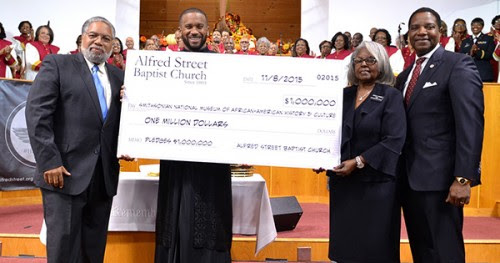
Alexandria, VA — In the final days of 2015, Alfred Street Baptist Church (ASBC), one of the nation’s oldest historically African American churches located in Alexandria, Virginia, announced that it is pledging to donate $1 million to the Smithsonian’s new National Museum of African American History and Culture (NMAAHC).
As such, the $1 million donation to the museum is the largest from a faith-based organization to date, thus allowing the church to be designated as a founding donor of the museum.
Scheduled to open in the fall of 2016 on the National Mall in Washington, DC adjacent to the Washington Monument, the museum will be a place where visitors can learn about the richness and diversity of the African American experience, what it means to the lives of the American people, and how it helped shape this nation.
Rev. Dr. Howard-John Wesley, the esteemed pastor of Alfred Street Baptist Church said:
“We are very proud and honored to make this contribution to a museum that promises to contribute immensely to the knowledge base of African American history and culture.
This historic attraction will be an astounding and visionary force in our communities and lives for decades to come. More importantly, we as a church, understand the importance of learning about the accomplishments of African American people. Therefore, we realize that if we don’t tell and preserve our own history, our children will never know their real value.”
Accepting the donation on behalf of the Smithsonian’s NMAAHC was Lonnie Bunch, founding director of the museum, who said, “We are honored to have the support of Alfred Street Baptist Church, an institution that has generously served its community for more than 200 years and whose support will help ensure that the museum fulfills its mission to tell the American story through an African American lens.”
James McNeil, chairman of the Board of Trustees of Alfred Street Baptist Church, continued:
“We are pleased to be the first faith-based organization to contribute $1 million to this magnificent cultural development. I challenge others in the faith-based community to follow suit to ensure that the history of African Americans will be celebrated and shared with everyone regardless of their background. The story of our country’s greatness cannot be told without sharing how we live and work together to help America thrive.”