Press "Enter" to skip to content

Posts published in “U.S.”

In Rediscovered Letter From 1865, Former Slave Tells Old Master To Shove It (UPDATE)

wpid-r-55872223-large570-2012-02-5-00-55.jpg
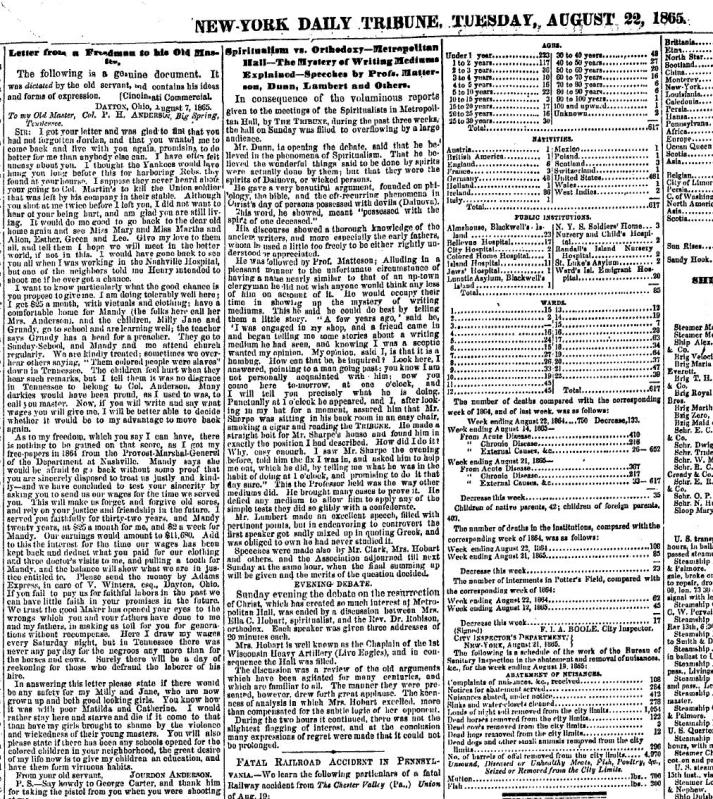
In the summer of 1865, a former slave by the name of Jourdan Anderson sent a letter to his former master. And 147 years later, the document reads as richly as it must have back then.  The roughly 800-word letter, which has resurfaced via various blogs, websites, Twitter and Facebook, is a response to a missive from Colonel P.H. Anderson, Jourdan’s former master back in Big Spring, Tennessee. Apparently, Col. Anderson had written Jourdan asking him to come on back to the big house to work.  In a tone that could be described either as “impressively measured” or “the deadest of deadpan comedy,” the former slave, in the most genteel manner, basically tells the old slave master to kiss his rear end. He laments his being shot at by Col. Anderson when he fled slavery, the mistreatment of his children and that there “was never pay-day for the Negroes any more than for the horses and cows.”  Below is Jourdan’s letter in full, as it appears on lettersofnote.com. To take a look at what appears to be a scan of the original letter, which appeared in an August 22, 1865 edition of the New York Daily Tribune, click here. As Letters Of Note points out, the newspaper account makes clear that the letter was dictated.
UPDATE:
After reading the letter attributed to Jourdon Anderson, Michael Johnson, a professor of history at Johns Hopkins University in Baltimore, did a bit of digging into old slave and census records. He says he has discovered evidence that the people involved in this correspondence are real, and that the letter is probably authentic.  According to Johnson, the 1860 federal slave schedules list a P H Anderson in Wilson County, Tenn., with 32 slaves; several of them credibly the people mentioned in the letter, of the correct genders and ages, Johnson said, though the names of slaves were not listed in the schedules.  “That in itself is not conclusive proof that the letter is real, but the slave owner was real and he had plenty of slaves,” Johnson wrote in an email to The Huffington Post.  Johnson said better evidence that the letter is almost certainly real is that, according to the 1870 federal manuscript census, a Jourdan Anderson, his wife and four school-age children are listed as living in the 8th ward of Dayton, Ohio. Johnson said the records state that Anderson is a hostler, 45, and that he and his family are listed as “black.” Furthermore, according to those records, Anderson, his wife and two older children, ages 19 and 12, were born in Tennessee. Two younger children, ages 5 and 1, were born in Ohio, “which would in turn have him and his family showing up in Ohio at about the right time to have escaped during the Civil War,” Johnson said.  The professor said that Jourdan Anderson could not read or write, according to 1870 manuscript census. But the letter could have been written by his 19-year-old daughter, Jane, who was listed as literate in 1870.  “The letter probably reflected his sentiments,” Johnson said, who added that Anderson lived in a neighborhood surrounded by working-class white neighbors who were literate, according to the census. It is also possible one of them may have written the letter for him, Johnson said.  But the person who most likely wrote the dictated letter is another person listed in Anderson’s letter.  In the letter Anderson refers to a V. Winters. According to Johnson a person by the name of Valentine Winters, a “barrister” in Dayton’s 3rd ward who claimed property worth $697,000, also appears in the 1870 federal census.  “He may well have been the person who actually wrote the letter since he is the person Jourdan Anderson asks his former master to send his wages to,” Johnson said.
Dayton, Ohio,
August 7, 1865
To My Old Master, Colonel P.H. Anderson, Big Spring, Tennessee
Sir: I got your letter, and was glad to find that you had not forgotten Jourdon, and that you wanted me to come back and live with you again, promising to do better for me than anybody else can. I have often felt uneasy about you. I thought the Yankees would have hung you long before this, for harboring Rebs they found at your house. I suppose they never heard about your going to Colonel Martin’s to kill the Union soldier that was left by his company in their stable. Although you shot at me twice before I left you, I did not want to hear of your being hurt, and am glad you are still living. It would do me good to go back to the dear old home again, and see Miss Mary and Miss Martha and Allen, Esther, Green, and Lee. Give my love to them all, and tell them I hope we will meet in the better world, if not in this. I would have gone back to see you all when I was working in the Nashville Hospital, but one of the neighbors told me that Henry intended to shoot me if he ever got a chance.
I want to know particularly what the good chance is you propose to give me. I am doing tolerably well here. I get twenty-five dollars a month, with victuals and clothing; have a comfortable home for Mandy,—the folks call her Mrs. Anderson,—and the children—Milly, Jane, and Grundy—go to school and are learning well. The teacher says Grundy has a head for a preacher. They go to Sunday school, and Mandy and me attend church regularly. We are kindly treated. Sometimes we overhear others saying, “Them colored people were slaves” down in Tennessee. The children feel hurt when they hear such remarks; but I tell them it was no disgrace in Tennessee to belong to Colonel Anderson. Many darkens would have been proud, as I used to be, to call you master. Now if you will write and say what wages you will give me, I will be better able to decide whether it would be to my advantage to move back again.
As to my freedom, which you say I can have, there is nothing to be gained on that score, as I got my free papers in 1864 from the Provost-Marshal-General of the Department of Nashville. Mandy says she would be afraid to go back without some proof that you were disposed to treat us justly and kindly; and we have concluded to test your sincerity by asking you to send us our wages for the time we served you. This will make us forget and forgive old scores, and rely on your justice and friendship in the future. I served you faithfully for thirty-two years, and Mandy twenty years. At twenty-five dollars a month for me, and two dollars a week for Mandy, our earnings would amount to eleven thousand six hundred and eighty dollars. Add to this the interest for the time our wages have been kept back, and deduct what you paid for our clothing, and three doctor’s visits to me, and pulling a tooth for Mandy, and the balance will show what we are in justice entitled to. Please send the money by Adams’s Express, in care of V. Winters, Esq., Dayton, Ohio. If you fail to pay us for faithful labors in the past, we can have little faith in your promises in the future. We trust the good Maker has opened your eyes to the wrongs which you and your fathers have done to me and my fathers, in making us toil for you for generations without recompense. Here I draw my wages every Saturday night; but in Tennessee there was never any pay-day for the negroes any more than for the horses and cows. Surely there will be a day of reckoning for those who defraud the laborer of his hire.
In answering this letter, please state if there would be any safety for my Milly and Jane, who are now grown up, and both good-looking girls. You know how it was with poor Matilda and Catherine. I would rather stay here and starve—and die, if it come to that—than have my girls brought to shame by the violence and wickedness of their young masters. You will also please state if there has been any schools opened for the colored children in your neighborhood. The great desire of my life now is to give my children an education, and have them form virtuous habits.
Say howdy to George Carter, and thank him for taking the pistol from you when you were shooting at me.
From your old servant,
Jourdon Anderson.

Y.M.C.A. Adopts Michelle Obama’s Recommended Health Policies for Youth

Chip Somodevilla/Getty Images

Michelle Obama, with Health and Human Services Secretary Kathleen Sebelius at a Y.M.C.A. event last year, has worked with the Y to develop health standards for its youth programs.

By 

WASHINGTON — The Y.M.C.A., one of the nation’s largest child-care providers, intends to announce Wednesday that it is adopting new “healthy living standards,” including offering fruits, vegetables and water at snack time, increasing the amount of exercise and limiting video games and television for youngsters in its programs.  The guidelines grow out of discussions the Y has been having with Michelle Obama, the first lady, and thePartnership for a Healthier America, a year-old nonprofit group dedicated to supporting Mrs. Obama’s campaign to reduce childhood obesity. The first lady will join Y officials for the announcement.

Roughly 700,000 youngsters are enrolled in early childhood, after-school and summer programs at 10,000 Y chapters around the country, and the organization has a broad reach into the lives of American families. Independent experts and White House officials say they hope the Y’s move will serve as a model for other day-care providers.

“The difference between kids getting a sugary beverage and an unhealthy snack versus water and an apple can change a kid’s life, if that’s what they are eating day in and day out after school,” said Sam Kass, Mrs. Obama’s top food policy adviser. “The Y sets a standard.”

The standards, however, will be voluntary; Neil Nicoll, president and chief executive of the Y.M.C.A. of the U.S.A., said the national organization could not impose them on chapters. But Mr. Nicoll said that they had been developed in consultation with Y leaders around the country, and that he expected 85 percent of chapters to comply.

“We don’t anticipate a lot of pushback,” he said. “We find that once kids get into healthy habits of eating carrots instead of cookies and being physically active instead of sitting in front of the screen, they go with the flow pretty easily.”

Specifically, the Y is urging its chapters to serve fruits and vegetables at each meal, and to offer water instead of juice. For young children, the guidelines call for 15 minutes of exercise per hour, no more than 60 minutes per day of screen time for 2- to 5-year-olds, and no screen time for children under 2. Older children would have 60 minutes a day of physical activity, and no access to television or movies. Digital devices would be used only for homework or programs that promote physical activity.

Mr. Nicoll estimates the changes will cost 50 cents per child per day; he said the Y was working with food vendors to help chapters buy discounted fruits and vegetables. It has also pledged an independent evaluation of the program’s effectiveness.

“The early childhood and youth development fields need more evidence of what works to prevent and treat obesity in children and adults,” said Carol Emig, president of Child Trends, a research organization not affiliated with the Y. “Hopefully, the Y experience will produce such evidence.”

The Y is the latest in a string of companies and organizations, including Wal-Mart and Walgreens, to sign onto Mrs. Obama’s initiative. This year, Bright Horizons, a company that provides day care to about 70,000 children, agreed to standards similar to those adopted by the Y.

The Partnership for a Healthier America, financed by philanthropies like the Kaiser Permanente and the Robert Wood Johnson Foundations, was founded to work with the private sector, and to ensure that Mrs. Obama’s initiative continues beyond her White House tenure. The Y will unveil its program at the partnership’s first conference; Mrs. Obama will be the keynote speaker.

“One in three kids are overweight or obese,” said Lawrence A. Soler, the partnership’s chief executive. “We are not going to be able to solve this problem in one or two presidential administrations.”

This article has been revised to reflect the following correction:

Correction: November 30, 2011

An earlier version of this article incorrectly described the source of funding for the Partnership for a Healthier America. It was financed in part by the Kaiser Permanente Foundation, not Kaiser Permanente.

Y.M.C.A. Adopts Michelle Obama's Recommended Health Policies for Youth

Chip Somodevilla/Getty Images

Michelle Obama, with Health and Human Services Secretary Kathleen Sebelius at a Y.M.C.A. event last year, has worked with the Y to develop health standards for its youth programs.

By 
WASHINGTON — The Y.M.C.A., one of the nation’s largest child-care providers, intends to announce Wednesday that it is adopting new “healthy living standards,” including offering fruits, vegetables and water at snack time, increasing the amount of exercise and limiting video games and television for youngsters in its programs.  The guidelines grow out of discussions the Y has been having with Michelle Obama, the first lady, and thePartnership for a Healthier America, a year-old nonprofit group dedicated to supporting Mrs. Obama’s campaign to reduce childhood obesity. The first lady will join Y officials for the announcement.
Roughly 700,000 youngsters are enrolled in early childhood, after-school and summer programs at 10,000 Y chapters around the country, and the organization has a broad reach into the lives of American families. Independent experts and White House officials say they hope the Y’s move will serve as a model for other day-care providers.
“The difference between kids getting a sugary beverage and an unhealthy snack versus water and an apple can change a kid’s life, if that’s what they are eating day in and day out after school,” said Sam Kass, Mrs. Obama’s top food policy adviser. “The Y sets a standard.”
The standards, however, will be voluntary; Neil Nicoll, president and chief executive of the Y.M.C.A. of the U.S.A., said the national organization could not impose them on chapters. But Mr. Nicoll said that they had been developed in consultation with Y leaders around the country, and that he expected 85 percent of chapters to comply.
“We don’t anticipate a lot of pushback,” he said. “We find that once kids get into healthy habits of eating carrots instead of cookies and being physically active instead of sitting in front of the screen, they go with the flow pretty easily.”
Specifically, the Y is urging its chapters to serve fruits and vegetables at each meal, and to offer water instead of juice. For young children, the guidelines call for 15 minutes of exercise per hour, no more than 60 minutes per day of screen time for 2- to 5-year-olds, and no screen time for children under 2. Older children would have 60 minutes a day of physical activity, and no access to television or movies. Digital devices would be used only for homework or programs that promote physical activity.
Mr. Nicoll estimates the changes will cost 50 cents per child per day; he said the Y was working with food vendors to help chapters buy discounted fruits and vegetables. It has also pledged an independent evaluation of the program’s effectiveness.
“The early childhood and youth development fields need more evidence of what works to prevent and treat obesity in children and adults,” said Carol Emig, president of Child Trends, a research organization not affiliated with the Y. “Hopefully, the Y experience will produce such evidence.”
The Y is the latest in a string of companies and organizations, including Wal-Mart and Walgreens, to sign onto Mrs. Obama’s initiative. This year, Bright Horizons, a company that provides day care to about 70,000 children, agreed to standards similar to those adopted by the Y.
The Partnership for a Healthier America, financed by philanthropies like the Kaiser Permanente and the Robert Wood Johnson Foundations, was founded to work with the private sector, and to ensure that Mrs. Obama’s initiative continues beyond her White House tenure. The Y will unveil its program at the partnership’s first conference; Mrs. Obama will be the keynote speaker.
“One in three kids are overweight or obese,” said Lawrence A. Soler, the partnership’s chief executive. “We are not going to be able to solve this problem in one or two presidential administrations.”

This article has been revised to reflect the following correction:
Correction: November 30, 2011
An earlier version of this article incorrectly described the source of funding for the Partnership for a Healthier America. It was financed in part by the Kaiser Permanente Foundation, not Kaiser Permanente.

US Army Selects First Black Female Two-Star General

marcia-anderson_US_Govt.jpg

Already the highest-ranking African-American female in the U.S. Army, Gen. Marcia Anderson’s recent promotion to the rank of major general makes her the first black woman to hold the title in the history of the military branch.
Anderson formerly served as a deputy-commanding general of the human resources command in Fort Knox, Kentucky. Now in the third highest-ranking position in the army, Gen. Anderson will now be stationed at the office of the chief of the U.S. Army Reserve in Washington, D.C.
The 30-year vet spoke to the Associated Press following her promotion. In her interview, the general spoke of the limited opportunities available for blacks prior to and the immediate years following World War II that affected many African-Americans, including her father.
“This is for people like him who had dreams deferred,” Anderson to the AP referring to her father’s failed dream of flying bombers during his time in the military. Her dad drove trucks instead because of the narrow opportunities for blacks at the time.
Anderson assumed her new post on September 30 in Washington, D.C.

(title)

WASHINGTON (AP) — Tourists and Washingtonians were about to get their first up-close look Monday at the memorial to the Rev. Martin Luther King Jr.
The site was set to open without fanfare around 11 a.m. to kick off a week of celebrations ahead of Sunday’s official dedication. About 20 people had lined up outside the site by late morning on what was a warm and sunny day.
Pamela M. Cross, 53, a cybersecurity professional from Washington, said she usually passes by the memorial on her morning walk around the National Mall and was excited to be able to see it up close.
Cross said her father, a postal worker, attended the march on Washington in 1963. She said King’s message continues to resonate.
“The way the country is right now, it’s good to remember his principles,” Cross said. “We are in need of jobs, we’re in need of equality, we’re in need of an economic vision that’s inclusive.”
The memorial sits on the National Mall near the Tidal Basin, between memorials honoring Presidents Abraham Lincoln and Thomas Jefferson. It includes a 30-foot-tall sculpture of King and a 450-foot-long granite wall inscribed with 14 quotations from the civil rights leader.
The sheer size of the sculpture of King sets it apart from nearby statues of Jefferson and Lincoln, which are both about 20 feet tall, though inside larger monuments.
A panel of scholars chose the engraved quotations from speeches by King in Atlanta, New York, Washington, Los Angeles and Montgomery, Ala., as well as from King’s books and his letter from a Birmingham, Ala., jail.
One of the stone engravings reads: “We shall overcome because the arc of the moral universe is long, but it bends toward justice.”
The sculptor, Lei Yixin, said he wanted the memorial to be a visual representation of the ideals King spoke of in his “I Have a Dream” speech.
“His dream is very universal. It’s a dream of equality,” Lei said through his son, who translated from Mandarin. “He went to jail. He had been beaten, and he sacrificed his life for his dream. And now his dream comes true.”
The 30-foot sculpture depicts King with a stern expression, wearing a jacket and tie, his arms folded and clutching papers in his left hand. Lei said through his son that “you can see the hope” in King’s face, but that his serious demeanor also indicates that “he’s thinking.”
The statue depicts King emerging from a stone. The concept for the memorial was taken from a line in the “I Have a Dream” speech, which is carved into the stone: “Out of the mountain of despair, a stone of hope.” Visitors to the memorial pass through a sculpture of the mountain of despair and come upon the stone of hope.
The National Mall site will be surrounded with cherry trees that will blossom in pink and white in the spring.
Sunday’s dedication ceremony will mark the 48th anniversary of the March on Washington and King’s famous “I Have a Dream” speech. President Barack Obama is scheduled to speak at the dedication.
via thegrio.com

Man Freed After Twenty-Seven Years In Prison For Crimes He Didn't Commit


By 

RICHMOND — After spending 27 years in prison for rapes and attacks prosecutors now say he did not commit, Thomas Haynesworth started a new life as a free man Monday.
At his mother’s cozy bungalow, where a spare bedroom has always waited for him, Haynesworth ate the Chinese takeout he had been craving — chicken fried rice for lunch. For the first time in his life, he placed a call on a cellphone. Two nieces he had just met crawled into his lap as he relaxed on a recliner in the living room.

It was his 46th birthday, and he was finally home.
“I’m just going to sit here and relax and spend time with my mother,” Haynesworth said.
Haynesworth was an 18-year-old high school dropout when was arrested as he walked to the market to buy sweet potatoes and bread for Sunday dinner. He told police they had the wrong man.
Now, nearly three decades later, Virginia Attorney General Ken T. Cuccinelli II and two prosecutors say they believe he was telling the truth. DNA and other evidence, they say, point to another attacker.
Haynesworth has his freedom, but he is still fighting to clear his name. He was released after Gov. Robert F. Mc­Don­nell (R) asked the parole board to review his case. The state of Virginia is supporting Haynesworth’s bid to have the Virginia Court of Appeals issue a “Writ of Actual Innocence.”
“I believe in Mr. Haynesworth’s innocence, and I will continue to work toward a complete vindication,” Cuccinelli said in a written statement.
Haynesworth said he will continue fighting for exoneration. He thinks the court “will see the truth,” he said.
But Monday was about celebrating and starting anew.
About 11:20 a.m., Haynesworth, wearing khaki pants and a button-down shirt, walked out of the Greensville Correctional Center in Jarratt carrying his television and a single garbage bag that held the rest of his belongings.
“He’s home,” his mother, Dolores Haynesworth, said as she tucked her arm around her son. “It’s still hard to believe. I’m holding him, but it’s still hard to believe.”
Haynesworth has never googled, used an ATM or traveled on an airplane. He doesn’t have a driver’s license. During nearly three decades behind bars, he was told when to eat, exercise and go to bed. He said he’s ready to catch up with a world he knows only from television and books.
But for starters, he craves simple things. He wants to sit on a porch, reconnect with old friends and enjoy some of his mother’s fried trout.
“It’s been a long journey,” Haynesworth said. “I just want to reflect and sit down and talk to my momma and eat a meal with her.”
Haynesworth was arrested on a February afternoon in 1984 when his mother sent him out to buy groceries. A woman who had been attacked days earlier saw Haynesworth and told a police officer he was the man.
Haynesworth, who had no criminal record, maintained from the start that he was innocent. But five women ultimately identified him as their attacker. He was convicted in three attacks and acquitted in one; one case was dropped.
In 2005, in the wake of the exonerations of five other wrongly convicted men, then-Virginia governor Mark R. Warner (D) ordered a sweeping review of thousands of criminal cases from 1973 through 1988. Haynesworth’s was among them.
Using technology that wasn’t available in the 1980s, authorities tested DNA collected from a January 1984 rape for which Haynesworth was convicted. The results cleared him and implicated a convicted rapist named Leon Davis.
The Mid-Atlantic Innocence Project took on Haynesworth’s case. DNA testing exonerated Haynesworth in a second rape in which he had been a suspect. Again, Davis was implicated.
Davis lived in the same neighborhood as Haynesworth. They resembled each other and have the same blood type.
Davis, who is jailed on other charges, has declined to be interviewed.
Haynesworth also was convicted in two attacks for which there is no genetic evidence. Prosecutors who have reexamined the cases are convinced he was wrongly convicted of those crimes, too.
Haynesworth said guards at the prison woke him up about 1 a.m. Monday to tell him he soon would be released. The other inmates gave him a birthday card that he brought home.
Hours later he was walking outside, hugging his mother and sisters. News photographers shot photos and reporters fired questions at him.
“Back in the hands of the people that love him,” a nephew said.
“I always believed this day would come,” Haynesworth said. “I didn’t think it would take 27 years.”
At home, he checked out his new bedroom and decided it would need some of his own touches. His mother’s dog, Stud, snapped at him. And he settled back in the easy chair as his mother prepared to whip up a dinner of scalloped potatoes, string beans and her son’s favorite trout.
“When we’re here tonight and it’s just the two of us, it will sink in,” she said.


Man Freed After Twenty-Seven Years In Prison For Crimes He Didn’t Commit

By 

RICHMOND — After spending 27 years in prison for rapes and attacks prosecutors now say he did not commit, Thomas Haynesworth started a new life as a free man Monday.

At his mother’s cozy bungalow, where a spare bedroom has always waited for him, Haynesworth ate the Chinese takeout he had been craving — chicken fried rice for lunch. For the first time in his life, he placed a call on a cellphone. Two nieces he had just met crawled into his lap as he relaxed on a recliner in the living room.

It was his 46th birthday, and he was finally home.

“I’m just going to sit here and relax and spend time with my mother,” Haynesworth said.

Haynesworth was an 18-year-old high school dropout when was arrested as he walked to the market to buy sweet potatoes and bread for Sunday dinner. He told police they had the wrong man.

Now, nearly three decades later, Virginia Attorney General Ken T. Cuccinelli II and two prosecutors say they believe he was telling the truth. DNA and other evidence, they say, point to another attacker.

Haynesworth has his freedom, but he is still fighting to clear his name. He was released after Gov. Robert F. Mc­Don­nell (R) asked the parole board to review his case. The state of Virginia is supporting Haynesworth’s bid to have the Virginia Court of Appeals issue a “Writ of Actual Innocence.”

“I believe in Mr. Haynesworth’s innocence, and I will continue to work toward a complete vindication,” Cuccinelli said in a written statement.

Haynesworth said he will continue fighting for exoneration. He thinks the court “will see the truth,” he said.

But Monday was about celebrating and starting anew.

About 11:20 a.m., Haynesworth, wearing khaki pants and a button-down shirt, walked out of the Greensville Correctional Center in Jarratt carrying his television and a single garbage bag that held the rest of his belongings.

“He’s home,” his mother, Dolores Haynesworth, said as she tucked her arm around her son. “It’s still hard to believe. I’m holding him, but it’s still hard to believe.”

Haynesworth has never googled, used an ATM or traveled on an airplane. He doesn’t have a driver’s license. During nearly three decades behind bars, he was told when to eat, exercise and go to bed. He said he’s ready to catch up with a world he knows only from television and books.

But for starters, he craves simple things. He wants to sit on a porch, reconnect with old friends and enjoy some of his mother’s fried trout.

“It’s been a long journey,” Haynesworth said. “I just want to reflect and sit down and talk to my momma and eat a meal with her.”

Haynesworth was arrested on a February afternoon in 1984 when his mother sent him out to buy groceries. A woman who had been attacked days earlier saw Haynesworth and told a police officer he was the man.

Haynesworth, who had no criminal record, maintained from the start that he was innocent. But five women ultimately identified him as their attacker. He was convicted in three attacks and acquitted in one; one case was dropped.

In 2005, in the wake of the exonerations of five other wrongly convicted men, then-Virginia governor Mark R. Warner (D) ordered a sweeping review of thousands of criminal cases from 1973 through 1988. Haynesworth’s was among them.

Using technology that wasn’t available in the 1980s, authorities tested DNA collected from a January 1984 rape for which Haynesworth was convicted. The results cleared him and implicated a convicted rapist named Leon Davis.

The Mid-Atlantic Innocence Project took on Haynesworth’s case. DNA testing exonerated Haynesworth in a second rape in which he had been a suspect. Again, Davis was implicated.

Davis lived in the same neighborhood as Haynesworth. They resembled each other and have the same blood type.

Davis, who is jailed on other charges, has declined to be interviewed.

Haynesworth also was convicted in two attacks for which there is no genetic evidence. Prosecutors who have reexamined the cases are convinced he was wrongly convicted of those crimes, too.

Haynesworth said guards at the prison woke him up about 1 a.m. Monday to tell him he soon would be released. The other inmates gave him a birthday card that he brought home.

Hours later he was walking outside, hugging his mother and sisters. News photographers shot photos and reporters fired questions at him.

“Back in the hands of the people that love him,” a nephew said.

“I always believed this day would come,” Haynesworth said. “I didn’t think it would take 27 years.”

At home, he checked out his new bedroom and decided it would need some of his own touches. His mother’s dog, Stud, snapped at him. And he settled back in the easy chair as his mother prepared to whip up a dinner of scalloped potatoes, string beans and her son’s favorite trout.

“When we’re here tonight and it’s just the two of us, it will sink in,” she said.


Obama Administration Drops Defense Of Anti-Gay Marriage Law

WASHINGTON (AP) — In a major policy reversal, the Obama administration said Wednesday that it will no longer defend the constitutionality of a federal law banning recognition of same-sex marriage.
Attorney General Eric Holder said President Barack Obama has concluded that the administration cannot defend the federal law that defines marriage as only between a man and a woman. He noted that the congressional debate during passage of the Defense of Marriage Act “contains numerous expressions reflecting moral disapproval of gays and lesbians and their intimate and family relationships – precisely the kind of stereotype-based thinking and animus the (Constitution’s)Equal Protection Clause is designed to guard against.”
The Justice Department had defended the act in court until now.
“Much of the legal landscape has changed in the 15 years since Congress passed” the Defense of Marriage Act, Holder said in a statement. He noted that the Supreme Court has ruled that laws criminalizing homosexual conduct are unconstitutional and that Congress has repealed the military’s “don’t ask, don’t tell” policy.
Holder wrote to House Speaker John Boehner, R-Ohio, that Obama has concluded the Defense of Marriage Act fails to meet a rigorous standard under which courts view with suspicion any laws targeting minority groups who have suffered a history of discrimination.
The attorney general said the Justice Department had defended the law in court until now because the government was able to advance reasonable arguments for the law based on a less strict standard.
At a December news conference, in response to a reporters’ question, Obama revealed that his position on gay marriage is “constantly evolving.” He has opposed such marriages and supported instead civil unions for gay and lesbian couples. The president said such civil unions are his baseline — at this point, as he put it.
“This is something that we’re going to continue to debate, and I personally am going to continue to wrestle with going forward,” he said.
Copyright 2011 The Associated Press.

Obama Signs Child Nutrition Bill


Washington (CNN) — President Barack Obama signed a sweeping overhaul of child nutrition standards Monday, enacting a law meant to encourage better eating habits in part by giving the federal government more authority to set standards for food sold in vending machines and elsewhere on school grounds.
Among other things, the $4.5 billion measure provides more money to poor areas to subsidize free meals and requires schools to abide by health guidelines drafted by the U.S. Department of Agriculture. To help offset the higher cost of including more fruits and vegetables, the bill increases the reimbursement rate for school lunches.
The bill is about “giving our kids the healthy futures they deserve,” the president said during a bill signing ceremony at a Washington elementary school. “Right now across the country too many kids don’t have access to school meals.”
Even when they do, he added, too often the meals aren’t sufficiently nutritious. As a result, he said, one out of every three children in America is overweight or obese.
Some Democrats had objected to the bill because it is funded in part by stripping $2.2 billion from the federal food stamp program. Congress also voted over the summer to take money from the program to fund legislation sending money to cash-strapped states to avoid teacher layoffs.
The cuts largely negate a spending increase provided to the food stamp program by the 2009 economic stimulus plan. Administration officials reportedly have promised anxious liberals that they will work to find ways to restore the higher funding levels.
The measure has been a top priority for first lady Michelle Obama, who has championed it as part of her “Let’s Move” initiative to combat child obesity in the United States.
“Had I not been able to get this bill passed, I would be sleeping on the couch,” the president joked shortly before signing the measure into law.
“We won’t go into that,” the first lady said. “Let’s just say it got done. Don’t have to go down that road.”

Good Black News Weekend Wrap Up – Sunday, April 11, 2010

Good Black News Weekend Wrap Up April 11, 2010

Listen to the Good Black News Weekend Wrap Up!  Listen by clicking the link above!