

Ambassador Andrew Young talks to the Tom Joyner Morning Show reflects about his friend, the late Martin Luther King, Jr. How he’s celebrating King Day: ‘I’m at Michigan State which is one of…
READ MORE: Ambassador Andrew Young Reflects On The Legacy Of MLK | Black America Web
Posts published in “History”

Chris Rock brought the powerful words of James Baldwin to life Monday during a tribute at the “MLK Now” event in Harlem honoring the late Martin Luther King, Jr.
The program, put together by the Campaign For Black Achievement and Blackout for Human Rights — organizations committed to social justice — took place at Harlem’s Riverside Church, where King delivered his riveting 1967 speech, “Beyond Vietnam: A Time To Break Silence.”
The event attracted a bevy of black Hollywood stars, who celebrated the legacy of King and other black historical icons. Some stars paid tribute through musical performances, like India.Arie, who praised Shirley Chisholm. Others, including Rock, gave powerful recitals.
Rock, who will host the Oscars next month, read the words to Baldwin’s widely praised 1963 letter, “My Dungeon Shook.” Watch Rock’s full performance (he takes the stage around the 1:44 mark) by clicking here.
“Creed” director Ryan Coogler, also the director and a founding member of Blackout for Human Rights, served as moderator for the event and introduced stars on the stage, including Harry Belafonte, Octavia Spencer, Jussie Smollett, Michael B. Jordan and India.Arie.
article by Lilly Workneh via huffingtonpost.com


Public television’s WORLD Channel will present the complete Emmy-Award winning Eyes on the Prize I and II starting tonight, January 17, 2016. A 30-minute special feature, Eyes on the Prize: Then and Now, will launch the encore presentation of this historic two-part series and explore its impressive relevance today.
Eyes on the Prize, created by Executive Producer Henry Hampton, is a critically-acclaimed and in-depth documentary series on civil rights in America. With the current national spotlight on issues of race and inequality—as well as the marking of the 50th anniversary of the Voting Rights Act, and the 60th anniversary of the Montgomery Bus Boycott—the time is right for this series about the nation’s civil rights history to be front and center as part of an essential dialogue.
America continues to struggle with the recurring crisis of race-related violence; Eyes on the Prize I and II can provide perspective for a new generation and be a touchstone for citizens who lived through the decades that the films depict. Journalist and writer Al Letson hosts new introductions to each episode.
“We are elated that this landmark series will once again be broadcast across the country, reaching millions of viewers—many of whom may never have seen the original airing. The series focuses on solutions to the conflicts that we face today. Eyes on the Prize shows leadership, grass roots organization and personal sacrifice as the recipe that can create lasting change. It is our hope the television programs together with our comprehensive outreach campaign will spark a national dialogue about this critical topic,” says Judi Hampton, president of Blackside, and sister of the late Henry Hampton (1940-1998).

The WORLD Channel presentation, made possible with support from the Corporation for Public Broadcasting and the Ford Foundation, includes Eyes on the Prize: Then and Now, a new, original 30-minute special, which will lead into the premiere January 17 of Eyes on the Prize, setting the groundbreaking documentary series in the context of today. Narrated by music artist Aloe Blacc, Eyes on the Prize: Then and Now features Eyes on the Prize filmmakers, present-day activists, human rights leaders, and scholars. The special revisits key historical moments and explores commonalities with current national events.
“The WORLD Channel is honored to be presenting this signature series,” says Chris Hastings, Executive Producer of the WORLD Channel. “It’s a history that must be understood. With Eyes on the Prize: Then and Now, we ask questions and draw comparisons about the struggle to achieve equality today. As conflicts and challenges continue, Eyes on the Prize remains essential viewing for all Americans.”
As part of the initiative, WGBH Education is developing a digital resource collection supporting Eyes on the Prize and civil rights themes in history and social studies curricula, to help the civil rights movement come alive for students today. This collection will be available on PBS LearningMedia in January.
Based at WGBH Boston, the national public media producer, WORLD Channel delivers the best of public television’s original documentary films and news to US audiences through local public television stations, including America ReFramed, AfroPop, POV and Local, USA. The special Eyes on the Prize presentation also will be made available to all public television stations for local broadcasts (check listings) after the WORLD premiere.
EYES ON THE PRIZE I and II
Almost three decades since its premiere, the groundbreaking series Eyes on the Prize I and II will return to PBS this January. Eyes on the Prize I will premiere on The WORLD Channel six consecutive Sundays – January 17, 24, 31 and February 7, 14, 21 at 9:00 p.m. (EST). Eyes on the Prize II will air eight consecutive Sundays—February 28, March 6, 13, 20, 27, and April 3, 10, 17 at 9:00 p.m. (EST).
Produced by Blackside, Eyes on the Prize tells the definitive story of the Civil Rights era from the point of view of the ordinary men and women whose extraordinary actions launched a movement that changed the fabric of American life and embodied a struggle whose reverberations continue to be felt today. This multi-part Academy Award nominated documentary is the winner of numerous Emmy Awards, a George Foster Peabody Award, an International Documentary Association Award, and a Television Critics Association Award.
Through contemporary interviews and historical footage, Eyes on the Prize I and II, traces the civil rights movement from the Montgomery bus boycott to the Voting Rights Act; from early acts of individual courage through the flowering of a mass movement and its eventual split into factions. The late Julian Bond, political leader and civil rights activist, narrates. Descriptions of each episode follow below:

Frances Dancy Hooks, the civil rights activist and widow of Dr. Benjamin Hooks, died Thursday, reports WREG TV. The prominent educator and philanthropist was 88.
As co-founder of the Memphis Volunteer Placement Program, she helped draw Black students to some of the nation’s best private boarding schools, notes the report.
Dr. Hooks died in 2010. He was the first African-American commissioner of the Federal Communications Commission, and served as executive director of the NAACP from 1977-1992.
From The Commercial Appeal:
Mrs. Hooks, 88, leaves behind a legacy of activism devoted to improving education, race relations and women’s rights in Memphis and across the nation.
A graduate of Booker T. Washington High School, Mrs. Hooks earned a bachelor’s degree from Fisk University in Nashville and a master’s degree from Tennessee State University. Mrs. Hooks began her 24-year career as an educator in Memphis but later served as secretary and adviser to her husband Ben, whom she called “the Catch of Memphis.”
“So many people think of her husband, Dr. Ben Hooks, but she was such a person of incredible competence in her own right,” said Jean Varnell, a friend of nearly 50 years. “They were such a team together.”

In celebration of the Dr. Martin Luther King Jr. holiday, SiriusXM’s Urban View (channel 126) will air audio of Dr. King’s ‘Lost’ speech, first delivered at the National Press Club in 1962 more than 50 years ago.
Considered of significant historical value, Dr. King became the first African American to speak at the Club and delivered the captivating speech in front of a segregated establishment just days after being released from jail in Albany, Georgia. In it, he reiterates his vision for non-violent protest as the best way to achieve racial equality.
An audio recording was made of the speech and filed away in the Club’s Archives and later transferred to the Library of Congress. No television footage of the speech in its entirety exists. Excerpts of King’s speech were unveiled this past Tuesday at a National Press Club event moderated by SiriusXM host Joe Madison.
Press Club President John Hughes also unveiled a permanent Club memorial to Dr. King’s speech. “Martin Luther King’s 1962 speech was one of the most important events to ever happen at the National Press Club,” Hughes said. “I am honored this event at long last is getting proper recognition with such distinguished guests.”
SiriusXM Urban View will air full audio on Monday, January 18 at 6:00 am, 8:00 am, 8:00 pm and 10:00 pm. All times are ET.

ARRAY @ The Broad is a brand new, ongoing series featuring classic and contemporary films curated with an eye toward the intersection of art, history and cultural identity. ARRAY, founded in 2010 by filmmaker Ava DuVernay, is an arts collective dedicated to the amplification of films by people of color and women filmmakers.
The monthly series aims to engage audiences through post-screening conversations with a spectrum of artists and scholars for an immersive exchange of ideas and insights beyond the screen that enliven many issues addressed by artists in the Broad collection.
DuVernay launched the series on December 10, 2015, bringing to the screen the 1961 film “Paris Blues,” starring Oscar-winning actor Sidney Poitier and Golden Globe-winning actress Diahann Carroll. The 35mm print was projected at the REDCAT theater to a sold-out audience, and was immediately followed by panel discussion moderated by Ms. DuVernay with some of her celebrated colleagues; director Ryan Coogler, actress Tessa Thompson, actor Andre Holland and Grammy nominated singer Ledisi.

She was born in Notasulga, Ala., but she didn’t like the way her story started, so she rewrote it and claimed Eatonville, Fla., as her birthplace instead. She wasn’t too partial to 1891, the year her mother delivered her, so she remixed it, and for the rest of her life, she took liberties with the mathematics of her age, knocking as many as 10 years off if the notion felt good to her.
Zora Neale Hurston was a master of creative invention and reinvention, from the personal details of her own life to her artistic catalog, which included four novels, two books of folklore, an autobiography, and dozens of short stories, essays, articles and plays. She was an original black girl unboxed.
It’s appropriate today, on what would be Zora’s 125th birthday, to honor the social and cultural freedoms she cleared for black female writers who stand on her platform and use our words to tell our own stories instead of allowing them to be told to and for us. She made it OK to be bold and conflicted, to wrestle with our identities and explore our differences as we chip away at the monolith, even to sometimes contradict ourselves and swerve, midaction, without apology.
Toni Morrison and Gloria Naylor, both literary geniuses, have credited Hurston as an inspiration, as do others, the famous and not so famous among us, who strip away pretense and dig into our personal wells of realness when we sit at a keyboard. We awe at the musicality of her prose and absorb what she said even in between the lines. This is what Hurston taught us, the black women creatives who came up in her shine.
You don’t need anybody’s permission to love who you uniquely are.
It’s appropriate today, on what would be Zora’s 125th birthday, to honor the social and cultural freedoms she cleared for black female writers who stand on her platform and use our words to tell our own stories instead of allowing them to be told to and for us. She made it OK to be bold and conflicted, to wrestle with our identities and explore our differences as we chip away at the monolith, even to sometimes contradict ourselves and swerve, midaction, without apology.
Toni Morrison and Gloria Naylor, both literary geniuses, have credited Hurston as an inspiration, as do others, the famous and not so famous among us, who strip away pretense and dig into our personal wells of realness when we sit at a keyboard. We awe at the musicality of her prose and absorb what she said even in between the lines. This is what Hurston taught us, the black women creatives who came up in her shine.
You don’t need anybody’s permission to love who you uniquely are.
“My mother had a number of books from the canon of black women’s literature. Among them was I Love Myself When I Am Laughing … and Then Again When I Am Looking Mean and Impressive, Alice Walker’s anthology of Hurston’s work. Just the book cover and the quote did so much to shift my thinking of what it means to be a woman. Her whole damn self is inspiring, a woman who loved herself at a time when self-hatred was expected of her. I find her to be contrary, instructive, insightful, bold and a perfect guide of who I can be if I dare.” —Writer and painter Kiini Ibura Salaam
Be audacious whenever appropriate, which is pretty much always.
Be audacious whenever appropriate, which is pretty much always.
“I first read Their Eyes Were Watching God in college and fell in love. The lyrical prose, dynamic black female protagonist, fresh use of humor and powerful affirmation of sisterhood all bewitched me. Zora’s personal narrative, however, scared me. I aspired to write, had already started publishing some of my work, and the experience of silence and invisibility both in Zora’s work and in her life freaked me out. I was inspired by her resistance to erasure, her insistence on voiced expression, but the last years of her life seemed so tragic. I was haunted by fear of a similar kind of dispossession, even as my own writing took off after college and graduate school. Then I read Wrapped in Rainbows by Valerie Boyd. She helped me understand Zora wasn’t dispossessed at all. She was free. And she could free me.” —Author Eisa Nefertari Ulen
Your talent will stretch across as many mediums and platforms as you will go.
“She refused to be pigeonholed into a single genre and craft. She was an amazing storyteller and cultural curator, as interested in collecting stories as she was in crafting them. Our creative lives are similar in that we study our people, culture and spirituality and write about them in plays, novels, stories and essays.” —M. Shelly Conner, Ph.D., writer and English instructor at Loyola University Chicago
You can’t do black womanhood one way, and you can’t do it wrong.
You can’t do black womanhood one way, and you can’t do it wrong.
“I’ve often said Zora Neale Hurston saved my life. My mother gifted me her copy of Their Eyes Were Watching God when I was 16 and immersed in agoraphobic depression. Reading Zora kept me afloat and made me realize my life would and could be bigger than my sorrows. Because she wrote so powerfully and honestly and amazingly about love and oppression and navigating turmoil from the perspective of a black woman, I wield my pen as a sword to cover the same terrain.” —Evette Dionne Brown, freelance culture, race and gender writer
Know that the minutiae of everyday life can be woven into literary tapestry.
Know that the minutiae of everyday life can be woven into literary tapestry.
“Zora was the first writer to make me feel like I could tell a story that mattered, a story that people would listen to. Her words have so much power, she makes me feel like mine do, too.” —Author Shameka Erby
Say what you have to say in only the way you can say it.
Say what you have to say in only the way you can say it.
“Zora Neale Hurston was fearless. At a time when being black was frowned upon and many writers were hoping to appease white America, she reveled in our culture and wrote in its voice. Whenever I question my voice, or whether or not I should ‘tone it down’ for the ‘mainstream,’ I think of her, and I write.” —Britni Danielle, freelance journalist and novelist
Speak for the people who don’t have the opportunity to be heard.
Speak for the people who don’t have the opportunity to be heard.
“Her work was honest. She wrote based on her experiences with people and provided voice to the voiceless through her characters. She was a true ethnographer depicting working-class black folks through her writing. Like her, I hope to give voice to the women that I write about in my scholarly endeavors.” —VaNatta Ford, Ph.D., visiting professor of Africana studies at Williams College
Trust your own (unconventional) approaches.
“It wasn’t until recently that I realized how much influence Zora Neale Hurston’s life and work had on my own life and work as a young ethnographer. The more I learned about and read her lesser-known anthropological work on black folklore, the more I realized that she, too, struggled early on to find her voice in academia. But what made her a significant influence to me was the fact that she lived by her wits, intuition and imagination. She continued to document black life even when academics criticized her approach. She trusted herself.” —Tara L. Conley, ethnographer and doctoral candidate, Columbia University
Outfit yourself in resilience and perseverance.
Outfit yourself in resilience and perseverance.
“My heart breaks knowing she died in poverty, buried in an unmarked grave. And yes, I know the great Alice Walker found the grave years later and purchased a headstone. Her end-of-life story, however, reminds me that literary notoriety is fickle and arbitrary and, as African-American women writers, we can help redeem the final chapter of Zora Neale Hurston’s life by never giving up in word or deed. That’s how her life and writing inspire me. Never give up. Keep going. Don’t stop. Ever. Always.” —Author Patricia Raybon
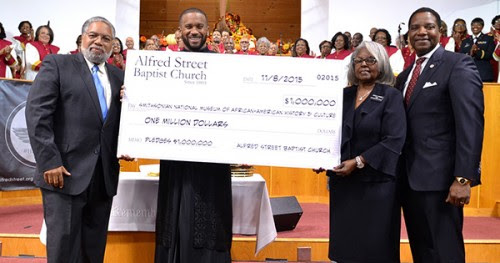
Alexandria, VA — In the final days of 2015, Alfred Street Baptist Church (ASBC), one of the nation’s oldest historically African American churches located in Alexandria, Virginia, announced that it is pledging to donate $1 million to the Smithsonian’s new National Museum of African American History and Culture (NMAAHC).
As such, the $1 million donation to the museum is the largest from a faith-based organization to date, thus allowing the church to be designated as a founding donor of the museum.
Scheduled to open in the fall of 2016 on the National Mall in Washington, DC adjacent to the Washington Monument, the museum will be a place where visitors can learn about the richness and diversity of the African American experience, what it means to the lives of the American people, and how it helped shape this nation.
Rev. Dr. Howard-John Wesley, the esteemed pastor of Alfred Street Baptist Church said:
“We are very proud and honored to make this contribution to a museum that promises to contribute immensely to the knowledge base of African American history and culture.
This historic attraction will be an astounding and visionary force in our communities and lives for decades to come. More importantly, we as a church, understand the importance of learning about the accomplishments of African American people. Therefore, we realize that if we don’t tell and preserve our own history, our children will never know their real value.”
Accepting the donation on behalf of the Smithsonian’s NMAAHC was Lonnie Bunch, founding director of the museum, who said, “We are honored to have the support of Alfred Street Baptist Church, an institution that has generously served its community for more than 200 years and whose support will help ensure that the museum fulfills its mission to tell the American story through an African American lens.”
James McNeil, chairman of the Board of Trustees of Alfred Street Baptist Church, continued:
“We are pleased to be the first faith-based organization to contribute $1 million to this magnificent cultural development. I challenge others in the faith-based community to follow suit to ensure that the history of African Americans will be celebrated and shared with everyone regardless of their background. The story of our country’s greatness cannot be told without sharing how we live and work together to help America thrive.”

In 1902 Julian Frances Abele was the first African American to graduate from the Graduate School of Fine Arts at the University of Pennsylvania. He was hired by the Horace Trumbauer architectural firm and spent his entire career there. He was responsible for the design on the Philadelphia Museum of Art, the Free Library of Philadelphia, and the Widener Memorial Library in Cambridge, Massachusetts.
Abele also designed many of the Gothic buildings on the campus of Duke University in Durham, North Carolina. But because of his race, the university did not originally celebrate the architect of many of its most important structures. Abele died in 1950 having never visited the Duke campus where he had played such an important role.
Abele’s role in designing the Duke campus did not become widely known until 1988. That year the university hung a portrait of Adele in the main administration building and another portrait was placed in the Rubenstein Library.
Now Richard Brodhead, president of Duke University, has called for the formation of an advisory board to come up with a plan to give proper recognition to Julian Abele by February 2016. President Brodhead said that “Julian Abele envisioned the physical world of Duke University. It is time to ensure that his legacy is clearly known so that future generations of students and faculty can be inspired by his genius.”
article vie jbhe.com

HARLEM — The Schomburg Center for Research in Black Culture is getting a $22 million facelift, officials announced Friday.
The ambitious renovation project includes installing a high-definition LED screen on the facade, new benches and landscape on Lenox Avenue, expansions to the gift shop and research spaces, and adding a new exhibition space for children.
“All of this makes for a really terrific start into the 21st Century and puts the Schomburg on its way its next 90 years,” said Director Dr. Khalil Gibran Muhammad.
The renovation comes at a time of growth at the research library, which is celebrating its 90th anniversary. Over the last three years their attendance has increased by 26 percent and program attendance by nearly 40 percent, according to NYPL President Tony Marx.
This is the most significant investment in the library named after Arturo Schomburg since its 1979 expansion, said the founder’s grandson Dean Schomburg.
RELATED:
- Schomburg Center for Research in Black Culture Announced as a 2015 Recipient of Nation’s Highest Museum and Library Honor
- Schomburg Center for Research in Black Culture Collects Past Stories of Those Who Wrestled With Their Sexuality
- Schomburg Center Digitizes Jim Crow Era “Green Books” Created to Help Black Travelers Avoid Racist Towns and Businesses
“I’m standing here thinking what my grandfather would have felt with what’s going on here today,” he said. “It would’ve been an enormous, enormous pleasure for him as it is for me to see what is happening.”
The research library’s reading room will get a makeover as will the video division. New storing and presentation equipment will make it easier for people to access historic recorded equipment, said Muhammad. “Some of the Schomburg’s greatest treasures are locked in hiding in those spaces and will begin to see the light of day again,” he said.
Scaffolding is already up on the south side of the building. The project is expected to be completed sometime in 2017.
article by Gustavo Solis via dnainfo.com