The cast of Oxygen’s “The Prancing Elites Project” reality show (Photo: OXYGEN.COM)
Get ready to see more sparkly leotards and the fiercest J-setting dance moves because Oxygen just greenlit a second season of The Prancing Elites Project.
The docuseries explores the world of competitive dancing through the lives of an all-male dance troupe based in Mobile, Alabama. All five members are African American, and a majority of them are gay.
Variety explains how the Prancing Elites were a godsend for the network after it rebranded itself in 2014; the program had the highest-rated series premiere after the rebranding.
That the show has generated such a strong following is also important because gay men are an underrepresented group. This platform gives them an opportunity to tell their own stories instead of being the sidekicks and the “gay” voice of reasoning for hetereosexuals in other reality-TV shows.
Plus, black gay culture has been one of the most appropriated cultures in recent years, with the advent of the Housewives franchise and other reality shows featuring straight women lobbing slang words at one another—words that were created or, at the very least, popularized by African-American gay men.
Season 2 will premiere in 2016; Oxygen is broadening the original 30-minute format to one hour. article by Diana Ozemebhoya Eromosele via theroot.com
Model of Beyoncé-inspired skyscraper (l); the inspiration (r) [photos via hollywoodreporter.com)
A skyscraper inspired by a fabric-wrapped body in Beyonce‘s “Ghost” music video is set to be built in Melbourne, Australia. According to Dezeen Magazine, the Elenberg Fraser firm won approval in May to build a 68-story curvaceous skyscraper that will boast 660 apartments and a 160-room hotel, along with retail space.
Parametric modeling was used to design the building’s form, which dips in and out throughout the exterior of the skyscraper. No completion date has been announced. The Premiere Tower at 134 Spencer Street was designed to respond to climate and wind changes: “The complex form – a vertical cantilever – is actually the most effective way to redistribute the building’s mass, giving the best results in terms of structural dispersion, frequency oscillation and wind requirements,” the Fraser website explains.
Watch the music video below:
“For those more on the art than science side, we will reveal that the form does pay homage to something more aesthetic – we’re going to trust you’ve seen the music video for Beyoncé’s ‘Ghost,'” the Elenberg Fraser site says.
(Image via philebrity.com)
Where would black cinema be in the 21st century without the films of NYU’s Spike Lee (“Do The Right Thing”, “School Daze”) and Dee Rees (“Pariah”, “Bessie”), or USC’s John Singleton (“Boyz N The Hood”, “Poetic Justice”) and Rick Fukiyama (“The Wood”, “Dope”), to name a few famous African-American film school graduates? From New York to New South Wales, the list of film schools below earn accolades for their filmmaking, television and animation programs, and may interest African-American filmmakers of the future: U.S. PROGRAMS: American Film Institute Los Angeles
AFI’s Conservatory is training 260 Fellows that are all, per the school, “worthy to watch.” The school’s participants create between four and 10 movies during the two-year program, and 37 alumni have received Oscar nominations in the past decade alone. An additional 118 have participated in award-winning projects ranging from “Boyhood” to “Mad Men.” Art Center College of Design Pasadena, Calif
The venerable private college’s film and graduate broadcast program continues to establish itself as an influential entity through its immersive curriculum and close working relationships between students and faculty. Its list of celebrated alumni includes director Zack Snyder and conceptual designers Ralph McQuarrie (“Star Wars”) and Syd Mead (“Blade Runner”). Boston U. Department Film & Television, College of Communication Boston
2015 saw the establishment of a one-year MFA program, as well as the Spelling Scholarship, named for producer Aaron Spelling, that will benefit up to 10 students. Nora Grossman is the latest BU alum to receive an Oscar nomination with her best picture nom for producing “The Imitation Game.” California Institute of the Arts Valencia
Generations of top animators and live-action filmmakers have benefited from CalArts’ diverse educational spectrum. Film/Video alum have won nine Oscars for animated film between 2003 and 2015, while domestic and international box office grosses from animated features helmed by alum directors rose to more than $31 billion. California State U. Northridge, Department of Cinema and Television Arts Northridge
CSUN’s Film Production alum have amassed an array of laurels from the screen industry, including awards from the Cannes Film Festival, DGA and Television Arts and Sciences Academy. The TV production program, too, has prepared students to work on series ranging from “The Amazing Race” to “Law & Order: SVU.” Chapman U., Dodge College of Film and Media Arts Orange, Calif.
Chapman’s Dodge College continues to provide both production and business-oriented culture to students interested in all facets of film, media and digital arts. Its production company, Chapman Filmed Entertainment, saw its first theatrical release, “The Barber,” open in theaters nationwide. Colorado Film School Denver
Colorado Film School hosts just 500 students, but produces more than 1,000 films yearly at its facility in Denver. It’s also one of the few institutions to offer a fully accredited university BFA professional training degree in production, and has partnered with ICM and top advertising agencies to offer internships. Columbia U. School of the Arts New York
An impressive array of film and television figures have received training from SoA’s MFA programs, which include visual arts, theater, film studies, writing and sound arts. Among its acclaimed alumni are directors Kathryn Bigelow, Nicole Holofcener and James Mangold, while past faculty includes producers Barbara De Fina and James Schamus. Columbia College Chicago Chicago
Practice and theory are emphasized at Columbia College Chicago’s Cinema Art + Science program, which offers nearly 200 specialized courses – the most comprehensive curriculum of any American film school. Students can also take advantage of its Semester in L.A., the only such program situated on a Hollywood studio lot. DePaul U. Chicago
The university’s School of Cinema and Interactive Media offers programs on every aspect of filmmaking, from directing to post-production. Students can take advantage of its exceptional digital media production equipment, and gain practical experience through its partnership with Cinespace Chicago, the largest film studio in the Midwest. Emerson College Visual & Media Arts School Boston
The Boston-based communications school further established itself as a direct conduit to the entertainment industry with its state-of-the-art Emerson Los Angeles building on Sunset Boulevard, which offers undergraduate, post-graduate and professional studies, as well as crucial internship opportunities. Alumni include Norman Lear and former MTV Networks president Doug Herzog. Florida State U., College of Motion Picture Arts Tallahassee
The film school’s selective admittance policy has paid off handsomely for FSU. Film school participants have won more Student Oscars and College Television awards in a single year than any other school — and the DGA recognized its “distinguished contribution to American culture through the world of film and television.” Ithaca College, Roy H. Park School of Communications Ithaca, N.Y.
Park School students are treated as industry professionals through close interaction with alumni and a full range of production scenarios through the student-run Studio, which allows them to develop, fund and distribute their own content. Student films have screened at or been honored by the American Society of Cinematographers, among others. Loyola Marymount U., School of Film and Television Los Angeles
LMU’s School of Film and Television is flush with impressive numbers, from the 400 partner companies who have hired alumni, including Disney, Sony and NBCUniversal, to the $1 million contributed to the local economy from 792 student productions — 41 of which were shot on the Red One digital camera. New York U. Tisch School of the Arts New York
The Maurice Kanbar Institute of Film & Television offers training to undergraduate and graduate students in a variety of cinematic storytelling media, from dramatic writing and interactive telecommunications to photography and imaging. Its prestigious roster of alumni includes Martin Scorsese, Spike Lee, Joel Coen and Ang Lee. Northwestern U., School of Communication Evanston, Ill.
Northwestern’s multidisciplinary arts education has produced major figures in nearly every aspect of film and television production, from three-time Oscar-nominated writer John Logan and Emmy-winning actress Julia Louis-Dreyfus to “Arrow” and “Flash” producer Greg Berlanti and such acclaimed producers and executives as Sherry Lansing, Jason Winer and Ken Kamins. Pratt Institute New York
The Brooklyn-based arts college has significantly increased its presence by relocating into a 17,000-sq.ft. space in Clinton Hill that will add 150 students to its 50-person film/video department. New additions can take advantage of Pratt’s expansive media curriculum, as well as the abundant internship opportunities inherent to New York City. Relativity School Los Angeles
The academic training arm of Relativity Media is a throwback to the studio system’s finishing schools, but with a significant difference: it benefits from both direct funding from the studio as well as an active production facility that offers students access to soundstages and production facilities on its 20-acre campus. Ringling College of Art and Design Sarasota, Fla.
The private, non-profit college has become a talent pool for studios seeking up-and-coming computer animators and designers. Ringling alumni captured Oscars for both animated feature (“Big Hero 6”) and short (“Feast”) at the 2015 ceremony, while students have won 11 of the past 13 student Academy Awards. Rhode Island School of Design Providence, RI
A diverse array of film and television talent, from Seth MacFarlane to Gus Van Sant, has graduated from RISD’s film/video/animation program, which is the largest in the state. Students study all three departmental disciplines in their sophomore year, which alumni have credited with expanding their visual and storytelling skills. Sarah Lawrence College Yonkers, N.Y.
Intimate seminar and workshop environments, an expansive and comprehensive program that incorporates screenwriting and media arts, and one-on-one mentorship with faculty advisors are among the high points of Sarah Lawrence’s film program. Notable graduates include J.J. Abrams, Peter Gould (“Better Call Saul”), Joan Micklin Silver and producer Amy Robinson. Savannah College of Art and Design Savannah, Ga.
Opportunities for prospective film and television students at SCAD are plentiful. The school features state-of-the-art technology and facilities, including a 60,000-sq.-ft. Digital Media Center and Savannah Film Studios; the annual Savannah Film Festival, which is the largest university film festival in America; and workshops and presentations with television professionals at TVfest. Stanford U. Palo Alto, Calif.
The lauded university’s film and media studies program is anchored in the visual arts. True to its reputation for selectivity, the MFA in documentary film and video admits only eight students per year, preaching artistic expression, aesthetics and social awareness as well as endeavors into new media. Syracuse U., College of Visual and Performing Arts Syracuse, N.Y.
Budding filmmakers in animation at Syracuse can look to celebrated alumni for inspiration, including directors Chris Renaud (“Despicable Me”) and Henry Selick (“Coraline”). The program’s ties with the Syracuse Intl. Film Festival open doors for student involvement. UCLA, School of Theater, Film and Television Los Angeles
Consistently considered one of the world’s best program’s, UCLA’s film program has hatched a platoon of filmmaking legends, from Francis Ford Coppola to documentarian Alex Gibney. Jeff Skoll’s recent gift of $10 million for the Skoll Center for Social Impact Entertainment refocuses the school on promoting social change through entertainment. U. of Southern California, School of Cinematic Arts Los Angeles
This beacon of excellence in filmmaking education continues to grow and expand. In Aug. 2013, construction began on the IMAX lab/theater space, which features two full-size IMAX projectors. This march, USC was voted best game design school in the country. U. of Texas at Austin, Moody College of Communication Austin
Moody College’s prestigious department of Radio-Television-Film offers a curriculum that focuses on the intersection of production, screenwriting and media studies. Home to the country’s first comprehensive 3-D production program, nearby festivals like SXSW provide inspiration and opportunity for both students and alumni. Vanderbilt U. Nashville, Tenn.
Located in the country’s homegrown arts mecca, students of the Nashville school’s Cinema and Media Arts program can hone in on a smorgasbord of topics like soundtracks, digital cinematography or 16mm shooting. The Vandy Meets Hollywood spring break program transports students to L.A. for studio visits and alumni networking. Wesleyan U. Middletown, Conn.
A leader in undergraduate film studies since the 1970s, the recent establishment of Wesleyan’s College of Film and the Moving Image has only expanded the umbrella program, which includes Wesleyan’s department of film studies, its cinema archives and the student-run film series. In April, the College of Film and the Moving Image announced a $2 million challenge grant from the Andrew W. Mellon Foundation. Yale U. New Haven, Conn.
Offering both undergrad and graduate degrees, Ivy Leaguers at Yale are trained in film history, theory, criticism and production. Students can also take advanced screenwriting courses, use resources at the university’s Digital Media Center for the Arts and study abroad at Prague’s famed Famu.
Keke Palmer And Sherri Shepherd’s Debut In ‘Cinderella’ On Broadway (Source: Jenny Anderson / Getty)
‘The Great White Way’ is seeing a serious dose of color these days.
In 2014, Black actors broke ground on Broadway when Norm Lewis became the first Black male to play the Phantom in Phantom of the Opera, and Keke Palmer played Rodger and Hammerstein’s first Black Cinderella on the stage. This year, Brandy scored another career milestone as the third notable Black actress to play femme fatale Roxie Hart in Chicago.And just last week, photos of Taye Diggs as Hedwig & The Angry Inch’s first Black male superstarhit the web to tons of excitement.
These inspiring moves are not only monumental for the actors, but also for the world of Broadway. While television and film are often called out for their extreme lack of diversity, Broadway has a long history of incorporating actors of color, as well as from the LGBT and disabled communities. And yet, despite impressive attempts at inclusivity, most people remain unaware of the strides made in the theater world.
To put it mildly, Hollywood could learn a lot from the Great White Way’s moves to culturally harmonize the stage. Brandy as “Roxie Hart: in “Chicago” (Source: Bruce Glikas / Getty)
Black actors first began standing under those bright white lights in 1920 when Charles Giplin became the first Black actor on Broadway to play the lead role in The Emperor Jones. Seven years later, Ethel Waters became the first Black actress in a lead role in Africana. Meanwhile, Show Boat was the first production to feature an integrated cast and even an interracial marriage.
The Roaring Twenties gave us our “Black firsts” on Broadway, but racism and segregation marred an otherwise elegant art scene, due much in part to the terrible effects of minstrelsty. Minstrels shows may not have been “Broadway” productions, but the racist shows garnered popularity nonetheless. Sometimes performed through the vaudeville platform (think baby Broadway), the productions continued through the 1960s, when fight for civil rights decreased their popularity.
Still, amid all of the setbacks, Black actors persevered by singing, dancing and acting their way into our hearts. More importantly, they did so not for the amusement of the White man, but out of their talent and genuine passion for the field.
In 1950, Juanita Hill was the first Black woman to win a Tony Award for a Supporting Role as Bloody Mary in South Pacific. Another Rodgers and Hammerstein production, the story was far from the famed duo’s most famous shows, but was notable for its tackling of the harmful affects of racism head-on.
The next 30 years would see a number of other noteworthy moments, including Diahann Carroll’s Tony Award for Best Actress in a Musical for No Strings. Vinnette Justine Carroll‘s achievement as the first Black female director of Don’t Bother Me, I Can’t Cope, the production of Ntozake Shange’s emotional For Colored Girls Who Have Considered Suicide / When the Rainbow Is Enuf, powerhouse actress Audra McDonald winning and of course Jennifer Holliday’s portrayal of Effie White in Dreamgirls:
But the last two years have been extremely notable for their high-profile and consistent opportunities for Black stage actors.Not only did Broadway darling Audra McDonald make history by winning her sixth Tony in 2014 (also becoming the only actress to win in all four acting categories), but Phyllicia Rashad won a Tony for the revival of A Raisin In The Sun and Denzel Washington shone in his much-praised role in August Wilson’s Pulitzer Prize-winning play Fences.
FX Networks has found its leads for Donald Glover’s comedy pilot Atlanta.Brian Tyree Henry, Lakeith Lee Stanfield and Zazie Beetz will co-star with Glover, who created and wrote the pilot. Community alum Glover grew up in Atlanta and has an active music career as a hip-hop artist, stage name Childish Gambino.
Atlanta revolves around two cousins on their way up through the Atlanta rap scene whose opposing views on art versus commerce, success and race will make their quest anything but easy. Henry, repped by Hartig-Hilepo Agency and JWS Entertainment, will play Alfred Miles, Atlanta’s hot of the moment rapper who plans to capitalize on the sudden fame as quickly as possible. Henry recurs on HBO’s Vice Principals. His other credits feature Puerto Ricans and TV’s The Knick, Boardwalk Empire, My America, The Good Wife and Law & Order.
Stanfield will play Darius, Alfred’s oddly talented right-hand man and musical collaborator. Stanfield’s film credits include Dope, Selma and Short Term 12, and will next be seen in the features Snowden, Straight Outta Compton and Miles Ahead. Beetz will play Van, a pragmatist caught up in a complicated relationship with Earn (Glover) due to their daughter. Beetz has appeared in the feature film Applesauce and the short films Beasts and The Crocotta. She will next appear in the feature Finding Her and is currently shooting Wolves for writer/director Bart Freundlich. They will join Glover, who plays Earn, a loner who left Atlanta only to return; now working an unglamorous job and barely getting by. When his cousin Alfred becomes Atlanta’s hot rapper, Earn sees an opportunity to manage Alfred’s career. Glover is repped by UTA, MGMT Entertainment and attorney Lev Ginsburg.
Hiro Murai will direct the pilot, which will be produced by FX Prods. Filming begins in Atlanta at the end of July. Glover executive produces with Paul Simms and Dianne McGunigle of MGMT Entertainment. article by Denise Petski via deadline.com
Screenwriters Kenya Barris and Tracy Oliver are re-teaming with Malcolm D. Lee for the “Untitled Girls’ Trip Project” at Universal. This project marks the second time the trio have worked together after Barbershop3, which is currently in production.
Barris is the creator of the ABC comedy series Black-ishand is also writing a feature adaptation of the 1970s TV show Good Times. Will Packer will be producing Girls Trip through his Will Packer Productions banner.
Lee’s highest-grossing film stateside was The Best Man Holidaywhich made $71 million. Barbershop 3 will be released on February 19 next year.
Packer’s next two titles at Universal are Straight Outta Comptonas Executive Producer, bowing August 14, and Ride Along 2, which opens on January 15 in 2016.
Lauryn Hill, The Roots, A$AP Rocky, Wale, Janelle Monae& Wondaland, Raekwon, Ghostface, The Internet, Raury, SZA, Scarface, and many more will take center stage at ONE Musicfestfestival in Atlanta on Saturday, September 12, 2015.
Over the last 6 years ONE Musicfest has pulled together the best of urban alternative legends and contemporaries for a unique experience through music and visual. And this year it gets even better, with ONE Musicfest in partnership with Live Nation, “pulling out all the stops with an outdoor music festival that the media says, can’t be missed, and attracting a generationally and culturally diverse audience. “
Beyond festival-goers having a good old-fashion time at the ONE Musicfest, Jason Carter, the founder of ONE Musicfest, told Black Enterprise.com exclusively, “I want people to walk away knowing that it’s possible for us all to share the same space. ONE Musicfest is a generational festival. It’s nothing to see a 17-year-old enjoying music along with someone in his or her late 40’s partying just as hard. So many times I think that’s overlooked with festivals. Some people will say, “That’s a young persons festival or that’s old school.” But the way we set up ONE Musicfest is so different—people jump up and dance when they hear a classic New Edition song and in the same breath once they hear the first drop on Kendrick Lamar, they’re bopping their head just as hard.
“The other WIN for One Musicfest is how we’ve brought progressive urban music to the stage. You never see Lauryn Hill on the same bill as Big Krit, but interestingly enough they’re fans of each other, but never get a chance to celebrate each other’s music together. So when they get backstage, they’re snapping pictures together and sharing them on Facebook and Instagram.”
According to a statement released by One Musicfest, the festival will take place on multiple stages and will serve as the ultimate mashup of innovative urban alternative acts with over eleven hours of non-stop music. The festival will feature over 25 of the hottest global DJs whose music crosses over to all spectrums, local vendors, games, and interactive activities. One Musicfest is the only place to see this roster of incredible acts join together for One purpose – which is to witness a wide variety of sounds, from rock to hip-hop, electro, reggae, funk, disco, house, alternative and soul while having your musical senses stimulated.
Founded by Jason Carter, ONE Musicfest has been one of Southeast’s largest home-grown, musical arts festivals to date including over 10,000 plus attendees. Carter has brought Atlanta music lovers the best and the brightest urban alternative acts performing in a welcoming, hospitable setting, creating an atmosphere where everyone can enjoy and discover music.
Previous artists include Kendrick Lamar, Nas, Jhene Aiko, Erykah Badu, Snoop Dogg, CeeLo Green & Goodie Mob, Santigold, Common, Method Man, Redman, Chrisette Michele, Amel Larriueux, Daley, Goapele, Joey Bada$$, De La Soul, Bilal, Quadron and more.
For more information, please visit www.onemusicfest.com and follow @ONEMusicfest | #OMF2015 | #ONLYOMF. article by Kandia Johnson via blackenterprise.com
Prima Ballerina Misty Copeland (Photo via livetalksla.org)
One of today’s most famous ballerinas just made history by becoming the first African-American woman to hold the position of principal dancer at the American Ballet Theater. Misty Copeland was promoted Tuesday after more than 14 years with the company, the New York Times reports. She spent eight of those years as a soloist, the Times points out.
Copeland, known for being vocal about the lack of representation and diversity in the company and in the realm of dancing in general, made the cover of TIME magazine just this year. She is also the subject of a documentary screened at the Tribeca Film Festival, the Times writes. In addition to being known for a popular Under Armour ad, she has a base of followers on social media larger than some of Hollywood’s finest.
But it’s Copeland’s precision and elegant fluidity while she dances that compound her popularity. That and her tendency to make history — her new post as principal dancer isn’t the first time her name will be written in books. Just this month, Copeland became the first African-American woman to star in “Swan Lake” with the Ballet Theater, a performance so well-attended that cheers from the crowd reportedly stopped parts of the show. From the NYT:
Ms. Copeland, who declined to be interviewed for this article, was unusually outspoken about her ambition of becoming the first black woman named a principal dancer by Ballet Theater, one of the nation’s most prestigious companies, which is known for its international roster of stars and for staging full-length classical story ballets.
“My fears are that it could be another two decades before another black woman is in the position that I hold with an elite ballet company,” she wrote in her memoir, “Life in Motion: An Unlikely Ballerina,” published last year. “That if I don’t rise to principal, people will feel I have failed them.”
This put an unusual public spotlight on Ballet Theater as it weighed the kind of personnel decision that, in the rarified world of ballet, is rarely discussed openly. If the company had not promoted Ms. Copeland, it risked being seen as perpetuating the inequalities that have left African-American dancers, particularly women, woefully underrepresented at top ballet companies.
Stella Abrera, Alban Lendorf, and Maria Kochetkova were all named principal dancers along with Copeland. article by Christina Coleman via newsone.com
Laurence Fishburne at NAACP Awards (photo via Variety.com)
Laurence Fishburne has been cast as Alex Haley in A+E Networks’ “Roots” remake, the History Channel announced Wednesday.
Haley is the author of the novel “Roots: The Saga of an American Family,” an American family origin story based around the life of Kunta Kinte. The “Roots” remake will be an original, contemporary production, incorporating material from Haley’s novel, as well as carefully researched new scholarship of the time.
“Roots” will be simulcast on A&E, History and Lifetime in 2016.
The Emmy-winning actor currently appears on NBC’s drama “Hannibal” and ABC’s half-hour comedy “Black-ish,” on which he also serves as executive producer. On the big screen, Fishburne will next be seen in Warner Bros. Pictures’ “Batman v Superman: Dawn of Justice.”
“Roots” is described as a historical portrait of American slavery recounting the journey of one family’s will to survive, endure and ultimately carry on their legacy despite enormous hardship and inhumanity. Spanning multiple generations, the lineage begins with young Kunta Kinte who is captured in his homeland in Gambia and transported in brutal conditions to colonial America where he’s sold into slavery. Throughout the series, the family continues to face adversity while bearing witness and contributing to notable events in U.S. history — including the Revolutionary and Civil Wars, slave uprisings and eventual emancipation. Will Packer, Marc Toberoff, Marc Wolper, Lawrence Konner and Mark Rosenthal serve as executive producers. LeVar Burton and Korin Huggins are co-executive producers. Konner, Rosenthal, Alison McDonald, and Charles Murray are writing. article by Laura Prudom via Variety.com
by GBN Lifestyle Editor Lesa Lakin
It’s here! Summer… and man, is there is a lot going on in the world. So if you just want some time to pause and do something fun alone or with loved ones, check out a few things happening this month. Personally I am looking forward to the Sneaker Exhibit. Enjoy July! IN CINEMA
ME AND EARL AND THE DYING GIRL
Rated PG-13 –NOW PLAYING
If you just want to catch a really great flick…. Me and Earl and The Dying Girl “lives” up to the hype. (Yes, I’ve seen it, and yes, I’ve got a lot to say… GBN review coming soon.) Oh, and Earl is the greatest character I’ve seen in a while. Highly Recommend. Check out the trailer here: https://youtu.be/2qfmAllbYC8
DOPE
Rated R – NOW PLAYING
Admittedly I’ve been benched for the last few months and not up on my reviews and screenings, but I have been meaning to see the critically acclaimed DOPE.
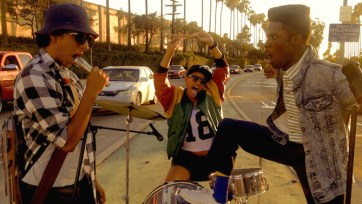
High-school senior Malcolm (Shameik Moore) and his friends Jib (Tony Revolori) and Diggy (Kiersey Clemons) bond over ’90s hip-hop culture, their studies and playing music in their own punk band. A chance encounter with a drug dealer named Dom lands Malcolm and company at the dealer’s nightclub birthday party; when the scene turns violent, they flee — with the Ecstasy that Dom secretly hid in Malcolm’s backpack. A wild adventure ensues as the youths try to evade armed thugs who want the stash.
“Southpaw” stars Jake Gyllenhaal and Curtis “50 Cent” Jackson (Photo via usatoday.com) I just saw the trailer for this and I’m hooked. Gotta say… I am loving Curtis “50 Cent” Jackson in the acting game. Antoine Fuqua (“Training Day”) directs. Check out the trailer here: https://youtu.be/Mh2ebPxhoLs
IN MUSIC
BROOKLYN, NY
July 8 – July 11, 2015 Brooklyn Hip Hop Festival: A celebration of Hip-Hop Culture and the Borough of Brooklyn Artists include: Common, Mobb Deep, Lion Babe, Freeway, Charles Hamilton, Pitch Blak Brass Band, Skyzoo, John Robinson, DJ Rob Swift, Torae, and “Uncle Ralph” McDaniels, http://www.bkhiphopfestival.com
July 18 – IRVINE, CA; July 19, 2015 – MOUNTAINVIEW, CA
Artists Include: The Game, Bone Thugs-N-Harmony, Ice T, Afrika Bambaataa and The Soulsonic Force, Big Daddy Kane, Rakim, Mack 10, Xzibit, Warren G, Rapper’s Delight, Kurtis Blow, Too Short, Doug E Fresh, DJ Quik, Kool Moe Dee, King T, Grand Master Melle Mel, Tha Alkaholiks, Biz Markie, Slick Rick, EPMD, Cold Crush Brothers, Ras Kass and other special guests. The event will be MC’d by Chief Rocker Busy Bee. https://www.facebook.com/artofrapfest RELATED: Ice-T Breaks Down Why “Art of Rap” Festival in July is Important to Hip-Hop, Art & Music July 30 – LOS ANGELES, CA Moses Sumney Thanks to my little sis, Ashley, I’m also recommending checking out the truly captivating musical artist-singer Moses Sumney. Check him out on SOUNDCLOUD:https://soundcloud.com/mosessumney He’s headlining the Echo in Los Angeles on July 30th. http://www.theecho.com/event/861489-moses-sumney-los-angeles/venue/ IN ARTS July 10-12 – DENVER, CO (Photo via colbaf.org)
The Colorado Black Arts Festival is excited to present the best of visual and performing arts to celebrate its 29th Annual Festival July 10-12, 2015 in historic Denver City Park West. This year’s Festival theme “Rock Steady” conveys the ability to excel in the arts with a rocking and soulful dimension. It represents a soulful genre that captures artistic rhythms with origins in the African diaspora. Rock Steady 2015! To learn more, go to: http://www.colbaf.org


 FX Networks has found its leads for Donald Glover’s comedy pilot Atlanta. Brian Tyree Henry, Lakeith Lee Stanfield and Zazie Beetz will co-star with Glover, who created and wrote the pilot. Community alum Glover grew up in Atlanta and has an active music career as a hip-hop artist, stage name Childish Gambino.
 way up through the Atlanta rap scene whose opposing views on art versus commerce, success and race will make their quest anything but easy. Henry, repped by Hartig-Hilepo Agency and JWS Entertainment, will play Alfred Miles, Atlanta’s hot of the moment rapper who plans to capitalize on the sudden fame as quickly as possible. Henry recurs on HBO’s Vice Principals. His other credits feature Puerto Ricans and TV’s The Knick, Boardwalk Empire, My America, The Good Wife and Law & Order.
 Screenwriters Kenya Barris and Tracy Oliver are re-teaming with Malcolm D. Lee for the “Untitled Girls’ Trip Project” at Universal. This project marks the second time the trio have worked together after Barbershop 3, which is currently in production.