

by Melissa Healy via latimes.com
When a customer opens the well-worn door to Eric Muhammad‘s barbershop in Inglewood, he’ll be looking to relax in the comfort and camaraderie of a neighborhood meeting place and maybe to take a little off the top or sides. If that visitor is among the close to 40% of African American men with high blood pressure, he might also get a little taken off the top of that vital health reading.
New research suggests that shops like Muhammad’s A New You Barber and Beauty Salon might be just the place to rescue African American men from an epidemic that has ravaged their ranks: uncontrolled hypertension.
The study found that when a group of African American men with untreated high blood pressure got a screening and a friendly nudge from their barber, as well as a visit to the shop from a pharmacist, close to two-thirds of the men brought their blood pressure into a healthy range. Their systolic blood pressure — the top-line number that measures the pressure in your vessels when the heart beats — fell by an average of 27 points. In addition, their diastolic blood pressure — the bottom number that measures pressure on the vessels’ walls between heart beats — fell by an average of nearly 15 points.
The 132 men who got a barbershop visit from a pharmacist were almost six times more likely to bring their blood pressure under control than were those who just got a barber’s advice to eat better, exercise more and see a doctor. Fewer than 12% of the 171 men in the latter group brought their blood pressure under control. (Their average reductions in systolic and diastolic blood pressure readings were too small to be considered statistically significant.)
The clinical trial was conducted from February 2015 to July 2017 in 52 black-owned barber shops across Los Angeles County. Two pharmacists specially trained to treat high blood pressure shuttled across a 450-square-mile area bringing advice and an array of medications to the study’s participants. “Bringing rigorous medicine directly to men in a barbershop, and making it so convenient for them, really made a difference,” said Dr. Ronald G. Victor, who led the new study.
“We had hoped for maybe a seven-point difference” between the two groups in their systolic blood pressure, the one that is considered a better predictor of heart attack and stroke risk, Victor said. “But this was a really big difference” — the kind that “could make an impact on a national level” if the initiative were scaled up, he said. “We were really ecstatic.”
The trial results were published in the New England Journal of Medicine and presented Monday at the American College of Cardiology‘s annual meeting. Victor said that the inclusion of two pharmacists — a white woman and a woman of color, each of whom turned in similar results — was the “secret special sauce” that appeared to bring participants’ blood pressure in check. But skilled as these pharmacists were, Victor said they might not have gained the trust and influence they eventually enjoyed if they had not been welcomed into barbershops and introduced by their trusted proprietors.
“I can’t emphasize enough how much the barbers’ buy-in made all the difference,” said Victor, the associate director of Cedars-Sinai’s Smidt Heart Institute. The African American shop owners who participated in the study had been in business an average of 17 to 18 years, and the men they enrolled had typically been coming to their shops for more than a decade, typically once every two weeks.
Muhammad was among the first to sign on to the study. The proprietor of his shop for 18 years, Muhammad helped recruit nearly half of the other barbers who participated in the trial. At the busy corner of La Brea and Florence avenues, Muhammad presides over a “refuge” whose door is open “whether you’re a doctor or a gang member.” For a lot of people, he said, “just being here is a blessing.” Muhammad said he has always considered himself a potential agent of health promotion. But “it certainly surprised me for a doctor to come up with that idea,” he said.
Victor said that his own hypertension had been diagnosed by a barber during a training session for an earlier version of this study in Texas. When Victor protested that he must have been momentarily tense while getting tested, the barber gently admonished him. “If you can’t relax in my barber chair, Doc, you’ve got a problem,” the stylist told him. “Now if you’re gonna talk the talk, you gotta walk the walk.”
Close to 40% of African American men have high blood pressure, a higher rate than any other ethnic group. And about one-third of those men — compared with 43% of white men and almost 50% of black women — have brought their hypertension under control with medication. This exacts a breathtaking toll among African American men in terms of death and disability. Their high rates of heart attack and stroke largely explain the 3.4-year difference in the life expectancy between blacks and whites in the United States.
Victor was optimistic that barbershops could help close that gap. “These are magical places,” he said. “They’re a window into some of the most positive aspects of black men’s social lives: loyalty, friendship, inclusiveness. There are dads bringing their sons in, customers who have come to the same place since they were children. These men were not in the clinic, that’s for sure.”
In African American communities, “we can map the places of black barbers right there alongside black ministers” as agents of trust and authority, said Vassar College history professor Quincy T. Mills.
Prospective patients might ordinarily view physicians and pharmacists with a suspicion borne of years of systemic abuses, Mills said. But in the familiar environment of their barbershop, “I suspect the men were comforted that these interactions were happening in a crowd of people, giving them space to ask others, to push back.”
Mills, the author of “Cutting Along the Color Line: Black Barbers and Barber Shops in America,” said that a man’s health is not a subject that routinely comes up while he is in the chair. But a barber’s position of leadership, his association with personal care and the connections he forges over time with his customers may allow him to stretch the bounds of what is permissible.
“That level of trust in the barber is the first critical piece here,” he said.
Source: http://www.latimes.com/science/sciencenow/la-sci-sn-barber-blood-pressure-20180312-story.html
Posts published in “Adults”
by Lori Lakin Hutcherson (@lakinhutcherson)
According to huffingtonpost.com, Grammy-nominated rapper Craig Mack, who performed the 1994 hit “Flava in Ya Ear” for Sean “Diddy” Combs’ Bad Boy label, has died at age 46. The New York Daily News confirmed his death with Alvin Toney, the producer of Mack’s breakout album, “Project: Funk Da World.”
 Mack succumbed Monday to heart failure at a hospital near his home in Walterboro, South Carolina, the producer said. He had been ill for some time. “It was a pleasure to know you & rock with you,” tweeted LL Cool J, who performed on Mack’s remix for “Flava in Ya Ear” with Notorious B.I.G., Busta Rhymes and Rampage.
The New York City-born rapper hit it big in his debut album for Bad Boy, “Project: Funk Da World,” which also generated a second single, “Get Down,” Billboard noted.
To read more about Craig Mack’s life and music, click here.
Hrabowski has propelled UMBC from a small, regional college 25 years ago to an institution known for its excellence in math and science, as well as for the high numbers of students of color who go on to earn doctorates and medical degrees.
In speaking at the UMBC graduation in 2016, Harvard President Drew Gilpin Faust said that Hrabowski had made the university into “a shining example of innovation in STEM education — and a premier pathway for students from all economic, racial and ethnic backgrounds to achieve doctoral degrees in medicine, science and technology.”
“The Meyerhoff Scholars Program alone is a ladder that has lifted more than 900 minority and low-income graduates to advanced degrees in math, science and medicine,” she said.
Hrabowski co-founded the Meyerhoff Scholars Program in 1988 with philanthropist Robert Meyerhoff. The program is open to high-achieving students interested in pursuing advanced research in science and engineering. The award is the latest of Hrabowski’s accomplishments. He has been named one of “America’s Best Leaders” by U.S. News & World Report. He chaired the National Academies’ committee that produced a 2011 report on expanding minority participation in science and technology. In 2012, then-President Barack Obama made him chair of the President’s Advisory Commission on Educational Excellence for African Americans.
“I am honored to accept this award on behalf of the UMBC community,” Hrabowski said in an email. “This achievement represents the work of so many colleagues here, people who have given their careers to serving students.”
Source: http://www.baltimoresun.com/news/maryland/education/bs-md-co-freeman-hrabowski-award-20180227-story.html

by Ashleigh Atwell via blavity.com
A jury awarded Ellen Harris, a nurse in Honolulu, Hawaii, over $3.8 million in damages after she claimed her employer ignored her reports of racial harassment, according to a press release from Harris’ lawyer.
Harris, who is black, worked in the Medical Intensive Care Unit at The Queen’s Medical Center from 2006 to 2011. During her time there, she reported a “potentially fatal event” involving another nurse who was allegedly harassing her.
When she told officials about the incident, her supervisor told her to write a statement; which she did. The day after she turned in her statement, she found a note in her work mailbox that read “LAZY *SS N*GGER B*TCH.”
Harris made another report and mentioned that the nurse who was harassing her was also acting “erratic,” and may have been under the influence. That nurse later resigned after the supervisor discovered she had been stealing “tremendous” amounts of fentanyl, a highly addictive narcotic. Harris’ supervisor and the hospital’s human resources director investigated the matter, and concluded that the note wasn’t threatening, but rather “a comment on Harris’ work ethic and communication skills.”
It took seven weeks for the investigators to interview two parties related to the note, and on Christmas Eve 2011, the night after the second person was interviewed, Harris found a picture of a noose taped to her locker. The incident was reported to Honolulu Police and investigated as terror threat.
Harris, who worked the night shift, requested a security escort to her car, additional security in the MICU, the results of any investigations and an apology. The HR department denied her security escort because the incidents didn’t occur in the parking lot.
She filed a lawsuit in 2013. Five years later, after a five week trial, Harris got her day in court. The jury declared that Harris was entitled to $630,000 in general damages and $3.2 million in punitive damages. Harris was happy with the decision and expressed that her safety, along with that of her patients, was important to her.
“I am so grateful to this jury for hearing my case and understood this is wrong. No one should be degraded or threatened like this,” Harris said. “I was only trying to make sure my patients were safe and received critical care they needed. After I found the noose on my locker, I did not think my patients or I were safe. Nurses depended on each other in the MICU. I was afraid something would happen to one of my patients or me after receiving this threat of violence.”
Source: https://blavity.com/nurse-that-received-note-reading-lazy-ss-ngger-picture-of-a-noose-awarded-over-38-million-in-damages?utm_content=bufferfc805&utm_medium=social&utm_source=twitter.com&utm_campaign=buffer
by Lauren Alexis Fisher via harpersbazaar.com
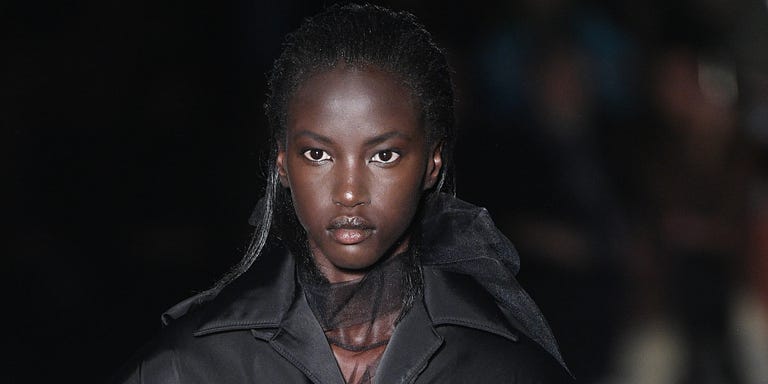
Last week, model Anok Yai made history at Prada‘s Fall 2018 show during Milan Fashion Week.
The 19-year-old became the second black model to ever open a Prada show. The first was Naomi Campbell back in 1997. Yes, it’s been over two decades since a woman of color opened a Prada runway.
Anok took to Instagram to thank Miuccia Prada, along with her team, for the opportunity, writing, “Can’t believe I’m the first black woman to open for Prada since queen @iamnaomicampbell, forever grateful.”
The model’s monumental runway walk is especially incredible as she was just discovered last fall while attending Howard University’s homecoming. Weeks later, she signed with Next Models. And just one month ago, she made her runway debut at Prada’s Menswear Fall 2018 show.
Of course, the fact that Prada hasn’t cast a woman of color to open its show in over two decades is problematic in itself. In the past, the brand has come under scrutiny for its lack of diversity both on the runway and in its campaigns. Hopefully, Anok opening the Fall 2018 show is an indication the Italian fashion house is headed in the right direction when it comes to diversity.
Extremely slowly, but surely, more and more brands are recognizing the importance of casting diverse runways. This season’s Fall 2018 shows at New York Fashion Week marked the most racially diverse of all time—with women of color accounting for 37.3% of all castings. Still, there’s a lot of work to be done.
Source: https://www.harpersbazaar.com/fashion/models/a18696458/anok-yai-black-model-prada-show/

by Nigel Roberts via newsone.com
Next week, Baltimore is expected to open the Office of African American Male Engagement to reduce the Black male incarceration rate, at a time when the city’s homicide rate is sky high–setting a record per capita rate in 2017. This program will hopefully save lives and end the cycle of incarceration.
“We want to save lives. The reason the office is important is because too many Black men are either the perpetrators of crime or victims of it. It is about saving lives,” said Andrey Bundley, who’s leaving his position as safety director for Baltimore City Public Schools to lead the new office, according to the Baltimore Sun.
Mayor Catherine Pugh opens the new office on Feb. 12. Modeled on a similar program in Philadelphia, the Baltimore initiative focuses on providing mentoring and a range of services for boys and men. It will connect to existing mentoring programs and includes a focus on men returning home from prison.
This effort is much needed. Baltimore was one of the most dangerous cities in America in 2017, setting a new per-capita homicide record of 343 killings. The police arrested tens of thousands of African-American males last year. And in many cases, once these young men were caught in the criminal justice system, many of them become repeat offenders. It was estimated in 2015 that 73 percent of former inmates in Baltimore City re-offend within three years.
The program seeks to create a support network, Bundley said. “We need that kind of space for individuals who don’t have a father or who have come out of prison or who are going through the process of getting a job,” he added, noting that scores of young Black men in the city lack families that can help them readjust and stay out of trouble after incarceration.
To read full article, go to: https://newsone.com/3772849/baltimores-mayor-launches-program-to-reduce-black-male-incarceration/

NEW YORK — “Girls Trip” changed the game for Tiffany Haddish, and now she’s being honored as one of Essence Magazine’s “game-changers” at its annual “Black Women in Hollywood” awards.
“Girls Trip” was one of last year’s big hits and made Haddish a breakout star. The comedian is one of four women being honored at the March 1 event in Beverly Hills, California.
“The Chi” creator and “Master of None” star Lena Waithe will also be celebrated; she became the first black woman to win an Emmy for comedy writing last year.
Danai Gurira of “The Walking Dead” stars in the upcoming “Black Panther.” Gurira also created the Tony-nominated “Eclipsed,” among other works. Tessa Thompson broke new ground in her role in last fall’s superhero hit “Thor.”
Essence magazine editor Vanessa De Luca says the honorees are “raising their voices to benefit all women.”
Source: https://www.washingtonpost.com/entertainment/celebrities/essence-honors-game-changers-haddish-waithe-among-others/2018/02/06/54083e84-0b46-11e8-998c-96deb18cca19_story.html?utm_term=.ad9ee8c26f95

by Sameer Rao via colorlines.com
Tens of thousands of Philadelphia sports fans flooded the city’s streets on February 4 to celebrate the hometown Eagles’ 41-33 win over the returning champion New England Patriots in Super Bowl LII. According to U.S. News and World Report, many fans’ belligerence led to various instances of property damage, including a collapsed Ritz-Carlton Hotel awning, an overturned car, destroyed traffic poles and two reportedly stolen police horses.
Photos detailing this destruction on Getty Images and Twitter largely show white male perpetrators. The Philadelphia Police Department has not yet released a final arrest tally for the vandalism, but Ajennah Amir, a spokesperson for the the mayor’s office, told CNN of just three arrests. Black Lives Matter of Greater New York president Hawk Newsome called out the department’s treatment of these people—as compared to the aggressive policing of Black protesters at actions against police violence—in an interview with Newsweek.
“Somehow, it seems there’s a line drawn in the sand where destruction of property because of a sports victory is okay and acceptable in America,” Newsome explained. “However, if you have people who are fighting for their most basic human right, the right to live, they will be condemned.”
Newsome pointed out city officials’ seeming reluctance to condemn the property damage, including police sergeant Brian Geer’s tweet telling people to simply “go home”:
Newsome told Newsweek that this response was “a glaring example of White privilege.”
“You can riot if you’re White and your team wins, but if you’re Black and being killed, you can’t speak out,” he added.
Newesome also contrasted the situation in Philadelphia with the Baltimore Uprising, when Black city residents demonstrated following the death of Freddie Gray in police custody. Newsweek says those actions led to 34 arrests. “I can’t condemn them and neither can anyone else, especially not the media, especially not politicians when they condone people who are just drunk and destroying property because their team won,” Newsome said.
Source: https://www.colorlines.com/articles/black-lives-matter-activist-calls-out-white-privilege-post-super-bowl-property-damage
Tens of thousands of Philadelphia sports fans flooded the city’s streets on February 4 to celebrate the hometown Eagles’ 41-33 win over the returning champion New England Patriots in Super Bowl LII. According to U.S. News and World Report, many fans’ belligerence led to various instances of property damage, including a collapsed Ritz-Carlton Hotel awning, an overturned car, destroyed traffic poles and two reportedly stolen police horses.
Photos detailing this destruction on Getty Images and Twitter largely show white male perpetrators. The Philadelphia Police Department has not yet released a final arrest tally for the vandalism, but Ajennah Amir, a spokesperson for the the mayor’s office, told CNN of just three arrests. Black Lives Matter of Greater New York president Hawk Newsome called out the department’s treatment of these people—as compared to the aggressive policing of Black protesters at actions against police violence—in an interview with Newsweek.
“Somehow, it seems there’s a line drawn in the sand where destruction of property because of a sports victory is okay and acceptable in America,” Newsome explained. “However, if you have people who are fighting for their most basic human right, the right to live, they will be condemned.”
Newsome pointed out city officials’ seeming reluctance to condemn the property damage, including police sergeant Brian Geer’s tweet telling people to simply “go home”:
Newsome told Newsweek that this response was “a glaring example of White privilege.”
“You can riot if you’re White and your team wins, but if you’re Black and being killed, you can’t speak out,” he added.
Newesome also contrasted the situation in Philadelphia with the Baltimore Uprising, when Black city residents demonstrated following the death of Freddie Gray in police custody. Newsweek says those actions led to 34 arrests. “I can’t condemn them and neither can anyone else, especially not the media, especially not politicians when they condone people who are just drunk and destroying property because their team won,” Newsome said.
Source: https://www.colorlines.com/articles/black-lives-matter-activist-calls-out-white-privilege-post-super-bowl-property-damage

by Sameer Rao via colorlines.com
Tarana Burke first launched the #MeToo campaign in 2007 to build solidarity and healing power among Black girls and women who survived sexual assault. Nearly 11 years later, the organizer and activist will chronicle her and the movement’s journey in a memoir.
The Associated Press (The AP) reported today (February 2) that Burke is working with writer and fellow activist asha bandele on the upcoming book, titled “Where the Light Enters.” Simon & Schuster will publish it next year through 37 Ink, its imprint that previously released books by Issa Rae and Dr. Willie Parker.
Burke told The AP that the memoir will address her own “ordinary, extraordinary journey from victim to survivor to thriver,” as well as the evolution of the movement.
“The book will also help readers understand the often overlooked historical connections of the role sexual violence plays in communities of color, specifically Black communities, even today, while exploring ways the same communities have been both complicit and resilient,” Burke added. “More than anything, this memoir will provide survivors across the spectrum of sexual abuse a road map for healing that helps them understand that the ‘me too’ movement is more about triumph than trauma, and that our wounds, though they may never fully heal, can also be the key to our survival.”
via #MeToo Founder Tarana Burke Writes Memoir, ‘Where the Light Enters’ | Colorlines

via latimes.com
Gabrielle Bullock, 56, is the Los Angeles-based head of global diversity for the international architecture and design firm Perkins+Will, an 83-year-old company with a workforce of more than 2,000 professionals. Bullock is also something of a pioneer, one of only 404 African American women who are licensed architects in the U.S. In 2017, Bullock was appointed as president-elect of the International Interior Design Assn., which has more than 15,000 members in 58 countries.
“I’m an architect, so I lead projects 50% of my time,” Bullock said. “The other 50% of the time I’m the firm’s director of global diversity. I lead the strategy, monitor it, lead the diversity council that we have and try to build a more inclusive culture for the firm.”
Natural talent
Bullock said she discovered her natural artistic ability early on. “I always drew. I used to make my own stationery when I was 9 or 10 years old. I believe I had some talent from my mother, who was an artist. Art was my thing.” It was also what earned her a coveted spot at the Fiorello H. Laguardia High School of Music & Art and Performing Arts in her hometown of New York City.
Listening well, Part One
Mentors were few and far between, but Bullock was careful to listen intently when she heard someone give important information. One was a teacher named Mrs. Kravitz. Even though Bullock preferred drawing portraits and album covers, Mrs. Kravitz said, “‘You could be an architect.’ I only needed to hear that once. I went home and told my mom I was going to be an architect.” Bullock switched gears and began drawing buildings that she liked.
Painful inspiration
Bullock was a very observant child growing up, noting the differences when she traveled from the relative comfort of her family’s home in the Riverdale section of the Bronx through other parts of the borough that were stricken by poverty and blight.
“I had friends and family who lived in public housing,” Bullock said. “I saw how the black community was living, and it was an embarrassment. I wanted to change that. I thought about how I could redesign the housing environment for low-income people. If the windows were really small, I’d make great big windows. Everybody loves sunshine, right?”
Diversity driven
Bullock attended the prestigious Rhode Island School of Design, becoming only the second African American female graduate, in 1984. Not only did it help buttress her belief in more livable architecture, she got a reverse course in diversity when it became clear that the school’s professors didn’t know how to reach out to her. “Few seemed to know how to tailor their instructional approach to people of different cultures.”