Press "Enter" to skip to content

Posts published in “Commemorations”

International African American Museum in South Carolina Will Stand Where 100,000 Enslaved People Took 1st Steps on American Soil

by Manie Robinson via greenvilleonline.com

CHARLESTON – A swift, cool breeze lifts off the Cooper River. It frisks through the crowns of the towering palm trees that line the paved walkway. Small boats wobble in the calm waters on the east side of the Charleston peninsula. A neatly manicured patch of grass provides a tranquil spot for a blanket and a book. In the distance, the steel cables of the Ravenel Bridge stretch in splendor. To the right, flags fly over Fort Sumter, where the first shots of the Civil War were fired.

Soon, this waterfront will be home to the International African American Museum. The $100 million, 40,000-square foot facility will bridge solemn history and modern magnificence. It will offer captivating exhibits, engaging events and a breathtaking view of the Charleston Harbor.

However, this land is more than prime riverfront real estate. It connects deeply to the heritage the museum aims to commemorate. Ship voyage records reveal that nearly half of the enslaved Africans who were shipped to North America disembarked in Charleston. Many slaves took their first steps on American soil on this patch of land, which was once the largest wharf in North America. Historians estimate that more than 90 percent of all African-Americans can trace at least one ancestor to this land.

Eighteen years ago, former Charleston mayor Joe Riley pledged to build an iconic museum that honors that heritage and illuminates the achievements cultivated from that regrettable past. Since then, 37 other museums dedicated to African-American history and culture have been constructed. However, IAAM supporters contend that this land grants it a distinctive, visceral magnetism.

Riley’s vision has attracted support from city, county and state government, local business owners, national organizations and historians. Yet, Riley and IAAM chief executive officer and president Michael Boulware Moore (who is the great-great-great grandson of Civil War Hero and Congressman Robert Smalls) must raise millions more before construction can begin.

Moore’s passion for this project is personal. When he walks this pristine patch of grass, he can hear the shackles rattling as they dragged against the wooden planks. He can see his great-great-great-great grandmother walking across the wharf. “We know that she landed here. That’s sort of my original anchor to Charleston. It’s really deep emotional territory for me,” Moore said. “Every time I go, it hits me.”

“I understand the history that occurred there,” he said. “I understand tens of thousands of people, including my ancestors, disembarked there in chains. I am confronted by the emotions that must have been felt on that space and just by the enormity of what happened.”

The land’s significance

This serene site was once the epicenter of America’s ugliest enterprise. Nearly 250 years ago, this area was merely brackish marsh. Charleston merchant Christopher Gadsden converted it into the largest wharf in North America. It covered 840 feet from the Charleston Harbor to East Bay Street, between what are now Calhoun and Laurens Streets. Initially, Gadsden’s Wharf primarily serviced the rice industry. Eventually, it became a hub of the international slave trade. From 1783 to 1808, approximately 100,000 enslaved African men, women and children were forced into ships and carried on a voyage through darkness across the Atlantic Ocean into the Charleston Harbor.

According to historian and former South Carolina Historical Society archivist Nic Butler, on Feb. 17, 1806, the City Council of Charleston passed an ordinance stipulating that all vessels importing enslaved Africans port in Gadsden’s Wharf. Enslaved Africans were stored like crops in a wharf warehouse. Shackled to despair, hundreds of men, women and children died from fevers or frostbite. They were buried unceremoniously in a nearby mass grave. Those who survived those subhuman conditions were advertised in newspapers, sold and dispersed.

“Some have described it as the enslaved Africans’ Ellis Island,” University of South Carolina history professor Bobby Donaldson said. “If you can imagine people who endured and survived the Middle Passage from West Africa across the Atlantic, Gadsen’s Wharf is where they see land, where they see a dark and unknown future.”

Slaves were taken to different corners of the fledgling country. They toiled in fields to quicken the economy and fostered a lineage of influential American inventors, educators, soldiers, politicians, writers, philosophers, entrepreneurs, entertainers, activists and athletes.

UMBC President Dr. Freeman Hrabowski to Receive American Council on Education’s Lifetime Achievement Award

Hrabowski has propelled UMBC from a small, regional college 25 years ago to an institution known for its excellence in math and science, as well as for the high numbers of students of color who go on to earn doctorates and medical degrees.
In speaking at the UMBC graduation in 2016, Harvard President Drew Gilpin Faust said that Hrabowski had made the university into “a shining example of innovation in STEM education — and a premier pathway for students from all economic, racial and ethnic backgrounds to achieve doctoral degrees in medicine, science and technology.”
“The Meyerhoff Scholars Program alone is a ladder that has lifted more than 900 minority and low-income graduates to advanced degrees in math, science and medicine,” she said.
Hrabowski co-founded the Meyerhoff Scholars Program in 1988 with philanthropist Robert Meyerhoff. The program is open to high-achieving students interested in pursuing advanced research in science and engineering.   The award is the latest of Hrabowski’s accomplishments. He has been named one of “America’s Best Leaders” by U.S. News & World Report. He chaired the National Academies’ committee that produced a 2011 report on expanding minority participation in science and technology. In 2012, then-President Barack Obama made him chair of the President’s Advisory Commission on Educational Excellence for African Americans.
“I am honored to accept this award on behalf of the UMBC community,” Hrabowski said in an email. “This achievement represents the work of so many colleagues here, people who have given their careers to serving students.”
Source: http://www.baltimoresun.com/news/maryland/education/bs-md-co-freeman-hrabowski-award-20180227-story.html

CUNY Professor Patricia Smith Wins the $100,000 Kingsley Tufts Poetry Award

Patricia Smith is the 2018 winner of the $100,000 Kingsley Tufts Poetry Award for her collection “Incendiary Art: Poems.” (Photo by Rachel Eliza Griffiths)

via jbhe.com
Patricia Smith, who teaches in the English department at the College of Staten Island of the City University of New York System, has been selected to receive the 2018 Kingsley Tufts Poetry Award. The award, which comes with a $100,000 prize, is given annually by Claremont Graduate University in California to a poet who “is past the very beginning but not yet reached the pinnacle of his or her career.” The $100,000 prize is the largest in the world for a single volume of poetry.
Professor Smith was honored for her poetry collection Incendiary Art: Poems (Northwestern University Press, 2017), which explores tragedy and grief in black communities across America. It is her eighth published poetry collection.
Professor Smith was a finalist for the Neustadt Prize, a two-time winner of the Pushcart Prize, and a four-time individual champion of the National Poetry Slam, the most successful poet in the competition’s history.
Smith will receive the award April 19 at the Huntington Library in San Marino, California. The award is one of the largest annual monetary prizes given to a single book of poetry by a mid-career poet, according the Kingsley Tufts website. The award was established at Claremont in 1993 by Kate Tufts to honor her husband, an executive in Los Angeles-area shipyards who also wrote and published poetry.
Source: https://www.jbhe.com/2018/02/patricia-smith-wins-the-100000-kingsley-tufts-poetry-award/

Jordan Peele Becomes 1st African-American to Win Academy Award for Best Original Screenplay

Jordan Peele – Original Screenplay – ‘Get Out’ 90th Annual Academy Awards, Los Angeles, USA – 04 Mar 2018 (Photo by Rob Latour/REX/Shutterstock)

by Lori Lakin Hutcherson (@lakinhutcherson)
At last night’s 90th Annual Academy Awards ceremony, “Get Out” writer/director/actor Jordan Peele won the Oscar for Best Original Screenplay, the first African American to ever earn this honor. On Saturday evening, Peele also won Independent Spirit Awards for Best Feature and Best Director.
Last year, “Moonlight” writers Barry Jenkins and Tarell Alvin McCraney won the Oscar for Best Adapted Screenplay, and the first African American to win an Oscar in either writing category was Geoffrey Fletcher for “Precious” in 2009. The only other African-American to win for writing is John Ridley in 2013 for the Adapted Screenplay to “12 Years A Slave.” “Mudbound” writer/director Dee Rees made her own bit of history this year by being the first African-American woman nominated in the Best Adapted Screenplay category; the first woman ever nominated in either category was Suzanne DePasse in 1972 for “Lady Sings The Blues.”
Retired NBA superstar Kobe Bryant took home the Oscar with his creative partner Glen Keane for “Dear Basketball,” the first nomination and win for an African American in the Best Animated Short category.
The complete list of last night’s winners is below:

Best Picture:“The Shape of Water” (WINNER)
“Call Me by Your Name”
“Darkest Hour”
“Dunkirk”
“Get Out”
“Lady Bird”
“Phantom Thread”
“The Post”
“Three Billboards Outside Ebbing, Missouri”
Actress:
Frances McDormand, “Three Billboards Outside Ebbing, Missouri” (WINNER)
Sally Hawkins, “The Shape of Water”
Margot Robbie, “I, Tonya”
Saoirse Ronan, “Lady Bird”
Meryl Streep, “The Post”
Actor:
Gary Oldman, “Darkest Hour” (WINNER)
Timothée Chalamet, “Call Me by Your Name”
Daniel Day-Lewis, “Phantom Thread”
Daniel Kaluuya, “Get Out”
Denzel Washington, “Roman J. Israel, Esq.”

Director:
“The Shape of Water,” Guillermo del Toro (WINNER)
“Dunkirk,” Christopher Nolan
“Get Out,” Jordan Peele
“Lady Bird,” Greta Gerwig
“Phantom Thread,” Paul Thomas Anderson
Original Song:
“Remember Me” from “Coco,” Kristen Anderson-Lopez, Robert Lopez (WINNER)
“Mighty River” from “Mudbound,” Mary J. Blige
“Mystery of Love” from “Call Me by Your Name,” Sufjan Stevens
“Stand Up for Something” from “Marshall,” Diane Warren, Common
“This Is Me” from “The Greatest Showman,” Benj Pasek, Justin Paul
Original Score:
“The Shape of Water,” Alexandre Desplat (WINNER)
“Star Wars: The Last Jedi,” John Williams
“Dunkirk,” Hans Zimmer
“Phantom Thread,” Jonny Greenwood
“Three Billboards Outside Ebbing, Missouri,” Carter Burwell
Cinematography:
“Blade Runner 2049,” Roger Deakins (WINNER)
“Darkest Hour,” Bruno Delbonnel
“Dunkirk,” Hoyte van Hoytema
“Mudbound,” Rachel Morrison
“The Shape of Water,” Dan Laustsen
Original Screenplay:
“Get Out,” Jordan Peele (WINNER)
“Three Billboards Outside Ebbing, Missouri,” Martin McDonagh
“The Big Sick,” Emily V. Gordon & Kumail Nanjiani
“Lady Bird,” Greta Gerwig
“The Shape of Water,” Guillermo del Toro, Vanessa Taylor

Richard T. Greener, 1st Black Faculty Member of University of South Carolina, is Honored with Bronze Statue on Campus

Richard T. Greener (image via harvardmagazine.com)

via jbhe.com
Recently the University of South Carolina unveiled a nine-foot statue of Richard T. Greener on campus. The bronze statue, located between the library and the student health center, honors the first Black faculty member at the university.
In 1870 Richard T. Greener became the first African American graduate of Harvard University. He taught high school in Philadelphia and Washington before joining the faculty at the University of South Carolina in 1873, which for a brief period during Reconstruction admitted Black students. Greener also studied law at the university while teaching philosophy, Latin, and Greek. After Blacks were purged from the University of South Carolina at the end of Reconstruction, Greener worked at the U.S. Treasury Department and taught at the Howard University School of Law.
Katherine Reynolds Chaddock, a retired professor of education at the University of South Carolina, said that Greener “accomplished some worthwhile things at the university in the few years it was open during Reconstruction. He acquired scholarship money for poor students and established a preparatory program for freshmen. He even went to Howard University to recruit South Carolina students who had enrolled there, inviting them to return to their own state for a college education at the now-integrated university.”
Professor Chaddock is the author of a biography about Greener, Uncompromising Activist: Richard Greener, First Black Graduate of Harvard College (Johns Hopkins University Press, 2017).
Source: https://www.jbhe.com/2018/02/university-of-south-carolina-honors-its-first-black-faculty-member/

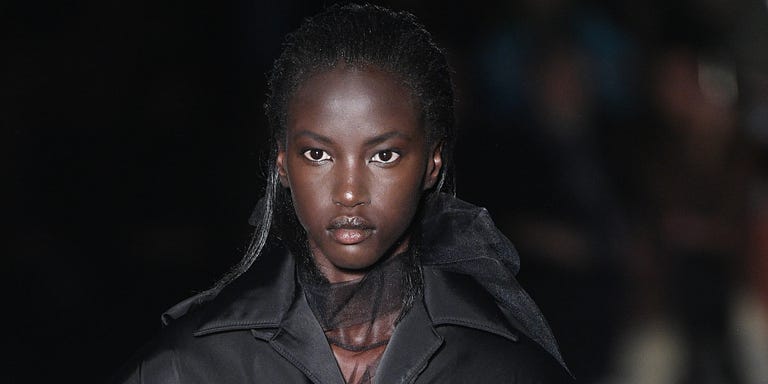
Anok Yai Becomes 1st Black Model since Naomi Campbell to Open the Prada Show at Milan Fashion Week

Model Anok Yai (Getty Images)

by Lauren Alexis Fisher via harpersbazaar.com
Last week, model Anok Yai made history at Prada‘s Fall 2018 show during Milan Fashion Week.
The 19-year-old became the second black model to ever open a Prada show. The first was Naomi Campbell back in 1997. Yes, it’s been over two decades since a woman of color opened a Prada runway.
Anok took to Instagram to thank Miuccia Prada, along with her team, for the opportunity, writing, “Can’t believe I’m the first black woman to open for Prada since queen @iamnaomicampbell, forever grateful.”

The model’s monumental runway walk is especially incredible as she was just discovered last fall while attending Howard University’s homecoming. Weeks later, she signed with Next Models. And just one month ago, she made her runway debut at Prada’s Menswear Fall 2018 show.

Of course, the fact that Prada hasn’t cast a woman of color to open its show in over two decades is problematic in itself. In the past, the brand has come under scrutiny for its lack of diversity both on the runway and in its campaigns. Hopefully, Anok opening the Fall 2018 show is an indication the Italian fashion house is headed in the right direction when it comes to diversity.

Extremely slowly, but surely, more and more brands are recognizing the importance of casting diverse runways. This season’s Fall 2018 shows at New York Fashion Week marked the most racially diverse of all time—with women of color accounting for 37.3% of all castings. Still, there’s a lot of work to be done.

Source: https://www.harpersbazaar.com/fashion/models/a18696458/anok-yai-black-model-prada-show/

Black Construction Companies Working on $350 Million Obama Presidential Center

Michelle Obama Barack Obama theGrio.com
(Photo by Mark Wilson/Getty Images)

via thegrio.com
Now that Barack Obama is out of the White House, he’s making a statement on support for Black businesses with a huge deal for the Obama Presidential Center.
The OPC is set to cost about $350 million, and an alliance of minority firms is set to get a large chunk of that. Powers & Sons Construction, UJAMAA Construction, Brown & Momen, and Safeway Construction, all part of the Presidential Partners consortium, have all come together as part of the Lakeside Alliance working on the presidential center, according to Black Enterprise.
The minority companies will be getting a 51% stake, while Turner Company, which is one of the nation’s largest construction companies, will have a 49% stake. It’s a historic move, not just because of the companies involved but because most minority firms will be hired on as subcontractors and not given majority stakes like this.
“The Obama Foundation believes in creating opportunities for diverse and local businesses and building pathways to meaningful jobs for minorities and other underrepresented populations,” said David Simas, CEO of the Obama Foundation.
“The development of the Obama Presidential Center gives us an opportunity to make a major, unprecedented impact on the South Side in terms of hiring talented, local businesses and individuals. We look forward to working with Lakeside Alliance to achieve our goals, set new benchmarks and make the Obama Presidential Center a landmark that our neighbors can be proud of.”
It’s a big win not just for the companies but the communities, because the alliance of minority companies has promised that they will be employing minority workers and people who live in the surrounding area for the massive project. That way, the companies will be giving back to the community and the presidential center will be a boon to Chicago’s South and West sides.
Ground will be broken for the project later on this year.

It's Official: ‘Black Panther’ Tops ‘Star Wars: The Last Jedi’ in Historic $242 Million 4-Day Opening

Disney-Marvel’s Black Panther” is re-writing the record books, topping “Star Wars: The Last Jedi” for the second-highest four-day domestic opening of all time, with $242 million at 4,020 North American locations.The superhero pic set a record for top Monday domestic gross ever, with $40.2 million, edging the previous high set by “Star Wars: The Force Awakens” at $40.1 million. The Monday total came in $7 million above the studio’s projections and lifted the four-day haul to $242 million.
Black Panther” has grossed the second-highest four-day total of all time, behind only “Star Wars: The Force Awakens” at $288.1 million and $400,000 ahead of “Star Wars: The Last Jedi.”
Disney also reported Tuesday that the international total has reached $184.6 million to lift the worldwide take to $426.6 million, led by South Korea at $27.1 million and the U.K. at $26.7 million.
The tentpole, starring Chadwick Boseman and directed by Ryan Coogler, has blown past its original tracking. The film, which carries an estimated $200 million production budget, had been tracking to bring in between an impressive $100 and $120 million when first projections emerged on Jan. 25.
Since then, “Black Panther” has become a must-see event as it’s veered into record-setting territory and has continued to shatter all projections since then. It has the highest three-day debut ever for a February film and the fifth-biggest of all time behind only “Star Wars: The Force Awakens” at $248 million, “Star Wars: The Last Jedi” at $220 million, “Jurassic World” at $208.8 million, and “The Avengers” at $207.4 million.
“Black Panther” has demolished the record for the largest Presidents Day weekend, blowing past “Deadpool’s” 2016 mark of $152 million.
Source: http://variety.com/2018/film/news/black-panther-box-office-tops-star-wars-last-jedi-1202704917/

Dr. David Blackwell, UC Berkeley’s 1st Tenured Black Scholar, Has a Building Named in His Honor

David Blackwell (photo via nytimes.com)

via jbhe.com
The University of California Berkeley is naming its newest residence hall in honor of David Blackwell. Dr. Blackwell, an accomplished statistician, was the first African American to be grant tenured at the university. He joined the mathematics department at Berkeley in 1954 and stayed on the faculty there until retiring in 1988. Dr. Blackwell died in 2010.
The new residence hall will house 750 undergraduate students and is expected to be ready to open this fall. Chancellor Carol Christ said that Professor Blackwell is “an exemplar of what Berkeley stands for: scholarly excellence of the highest caliber tied to a mission of social justice and inclusion.”
A native of Illinois, in 1935 Blackwell entered the University of Illinois at the age of 16. By 1941 he had earned bachelor’s, master’s, and Ph.D. degrees in mathematics. He then joined the Institute of Advanced Study in Princeton but left after one year. Professor Blackwell taught at Southern University and Atlanta University before joining the faculty at Howard University in 1944. At Howard, he became a full professor and chaired the department of mathematics. In 1965 Dr. Blackwell was the first African American to be inducted into the National Academy of Sciences.
Source: https://www.jbhe.com/2018/02/berkeleys-first-tenured-black-scholar-has-a-building-named-in-his-honor/?utm_campaign=20180215wb
 

Barack Obama and Michelle Obama Portraits Unveiled at National Portrait Gallery

Kehinde Wiley has set Mr. Obama against greenery, with flowers that have symbolic meaning: African blue lilies for Kenya, his father’s birthplace; jasmine for Hawaii, where Mr. Obama was born; chrysanthemums, the official flower of Chicago, for the city where his political career began. (Credit: Kehinde Wiley)

by Holland Cotter via nytimes.com
With the unveiling Monday at the National Portrait Gallery in Washington D.C. of the official presidential likenesses of Barack Obama and the former first lady, Michelle Obama, this city of myriad monuments gets a couple of new ones, each radiating, in its different way, gravitas (his) and glam (hers).

Ordinarily, the event would pass barely noticed in the worlds of politics and art. Yes, the Portrait Gallery, part of the Smithsonian Institution, owns the only readily accessible complete collection of presidential likenesses. But recently commissioned additions to the collection have been so undistinguished that the tradition of installing a new portrait after a leader has left office is now little more than ceremonial routine.

The present debut is strikingly different. Not only are the Obamas the first presidential couple claiming African descent to be enshrined in the collection. The painters they’ve picked to portray them — Kehinde Wiley, for Mr. Obama’s portrait; Amy Sherald, for Mrs. Obama — are African-American as well. Both artists have addressed the politics of race consistently in their past work, and both have done so in subtly savvy ways in these new commissions. Mr. Wiley depicts Mr. Obama not as a self-assured, standard-issue bureaucrat, but as an alert and troubled thinker. Ms. Sherald’s image of Mrs. Obama overemphasizes an element of couturial spectacle, but also projects a rock-solid cool.

It doesn’t take #BlackLivesMatter consciousness to see the significance of this racial lineup within the national story as told by the Portrait Gallery. Some of the earliest presidents represented — George Washington, Thomas Jefferson — were slaveholders; Mrs. Obama’s great-great grandparents were slaves. And today we’re seeing more and more evidence that the social gains of the civil rights, and Black Power, and Obama eras are, with a vengeance, being rolled back.

On several levels, then, the Obama portraits stand out in this institutional context, though given the tone of bland propriety that prevails in the museum’s long-term “America’s Presidents” display — where Mr. Obama’s (though not Mrs. Obama’s) portrait hangs — standing out is not all that hard to do.

Amy Sherald’s take on Mrs. Obama emphasizes an element of couturial spectacle (with a dress designed by Michelle Smith) and rock-solid cool. (Credit:  Amy Sherald)

Mr. Wiley, born in Los Angeles in 1977, gained a following in the early 2000s with his crisp, glossy, life-size paintings of young African-American men dressed in hip-hop styles, but depicted in the old-master manner of European royal portraits. More recently he has expanded his repertoire to include female subjects, as well as models from Brazil, India, Nigeria and Senegal, creating the collective image of a global black aristocracy.

In an imposingly scaled painting — just over seven feet tall — the artist presents Mr. Obama dressed in the regulation black suit and an open-necked white shirt, and seated on a vaguely thronelike chair not so different from the one seen in Stuart’s Washington portrait. But art historical references stop there. So do tonal echoes of past portraits. Whereas Mr. Obama’s predecessors are, to the man, shown expressionless and composed, Mr. Obama sits tensely forward, frowning, elbows on his knees, arms crossed, as if listening hard. No smiles, no Mr. Nice Guy. He’s still troubleshooting, still in the game.

His engaged and assertive demeanor contradicts — and cosmetically corrects — the impression he often made in office of being philosophically detached from what was going on around him. At some level, all portraits are propaganda, political or personal. And what makes this one distinctive is the personal part. Mr. Wiley has set Mr. Obama against — really embedded him in — a bower of what looks like ground cover. From the greenery sprout flowers that have symbolic meaning for the sitter. African blue lilies represent Kenya, his father’s birthplace; jasmine stands for Hawaii, where Mr. Obama himself was born; chrysanthemums, the official flower of Chicago, reference the city where his political career began, and where he met his wife.

Mrs. Obama’s choice of Ms. Sherald as an artist was an enterprising one. Ms. Sherald, who was born in Columbus, Ga., in 1973 and lives in Baltimore, is just beginning to move into the national spotlight after putting her career on hold for some years to deal with a family health crisis, and one of her own. (She had a heart transplant at 39.) Production-wise, she and Mr. Wiley operate quite differently. He runs the equivalent of a multinational art factory, with assistants churning out work. Ms. Sherald, who until a few years ago made her living waiting tables, oversees a studio staff of one, herself.

At the same time, they have much in common. Both focused early on African-American portraiture precisely because it is so little represented in Western art history. And both tend to blend fact and fiction. Mr. Wiley, with photo-realistic precision, casts actual people in fantastically heroic roles. (He modifies his heroizing in the case of Mr. Obama, but it’s still there.) Ms. Sherald also starts with realism, but softens and abstracts it. She gives all her figures gray-toned skin — a color with ambiguous racial associations — and reduces bodies to geometric forms silhouetted against single-color fields.

To read full article, go to: https://www.nytimes.com/2018/02/12/arts/design/obama-portrait.html

Portraits of Barack Obama and Michelle Obama
At the National Portrait Gallery, Smithsonian Institution, Washington; 202-633-1000; npg.si.edu.