

According to Variety.com, Universal Pictures has optioned the rights to Jason Reynolds‘ best-selling young adult novel “Long Way Down,” which was also a National Book Award finalist. John Legend‘s Get Lifted Film Co. and Michael De Luca‘s Michael De Luca Productions have signed on to produce the film.
Reynolds’ book has an unusual premise – the whole story takes place in 60 seconds, as a young man struggles to decide whether or not he’s going to murder the person who killed his brother. Additionally, the book is written in free verse and is set in an elevator.
Although Legend is best known for his work as a singer and songwriter, but he has also racked up some major film credits, appearing in the likes of “La La Land” and “Soul Men,” and has produced the television series “Underground.” Legend also shared an Academy Award with rapper Common for best original song in 2015 for writing “Glory” from the film “Selma.”
Reynolds’ novels include “All American Boy” and “As Brave as You.” De Luca is the former president of New Line Cinema as well as an Oscar-nominated producer whose credits include the “Fifty Shades” trilogy, “The Social Network,” and “Moneyball.”
Posts published in “Books”

by Nicole Hyatt, eurweb.com via blackamericaweb.com
While taking over hosting duties for “Jimmy Kimmel Live!” on Tuesday, Tracee Ellis Ross used the platform to speak out about the current wave of sexual harassment allegations surrounding Hollywood.
“I wrote a book,” she said, introducing a bit about “The Handsy Man,” her new children’s book that breaks down the issue of sexual harassment so that grown men can understand.
“It’s kind of like a children’s book for men that is going to make it really simple and bring it back to the basics,” she said before opening the cover and reading a passage.
“There is a guy, with 10 long fingers/ creepy glares and hugs that linger./ If you’re a woman, you’re not a fan./ I speak, of course, of The Handsy Man,” she read.
Ross went on to read all the things that “Handsy Man” may not do. “You may not compliment my butt. You may not call me ‘ho’ or ‘slut.’ And even if you’re stoned or drunk, do not expose me to your junk,” Ross read, showing a drawing of “Handsy Man” exposing himself to a woman.
Other passages included instructions to not “grab my boobs while I’m asleep,” an apparent reference to the photograph of Sen. Al Franken groping a sleeping Leeann Tweeden’s breasts, and one final message: “I’ll say it clearly, nice and slow. If she doesn’t consent — the answer is NO.”
Watch the video below:
Source: https://blackamericaweb.com/2017/12/06/tracee-ellis-ross-schools-men-on-sexual-harassment-with-childrens-book/

Michael B. Jordan has set legal drama “Just Mercy” as the next feature he will shoot, as Warner Bros. picks up the rights for the story.
The film was originally set up at Broad Green Pictures, but after the studio shuttered earlier this year, producers began looking for a new home, and Warner Bros. was eager to work with Jordan.
Sources say that Jordan would shoot “Just Mercy” at the beginning of 2018, and would follow that up with “Creed 2,” where he would reprise his role as Adonis Creed. “Creed 2” is slated to bow on Nov. 21, 2018. It’s currently unknown if it will stick to that date, but as of now, there’s no plan to move the release.
“Short Term 12” director Destin Cretton is helming and co-wrote the script with Andrew Lanham. Jordan will produce with Gil Netter. Niija Kuykendall will oversee for the studio.
Based on the book “Just Mercy: A Story of Justice and Redemption,” it follows the true story of Bryan Stevenson, a gifted young lawyer’s defense of the most vulnerable in our country and his fight for equal justice in a flawed legal system.
Along with “Just Mercy,” Jordan also recently set up his directing debut with “Stars Beneath Our Feet.” The actor is also gaining traction as a producer, as he is on board to produce a reboot of “The Thomas Crown Affair,” “Raising Dion,” and and untitled project with Tarell Alvin McCraney for OWN.
To read more, go to: http://variety.com/2017/film/news/michael-b-jordan-just-mercy-warner-bros-1202627412/

via blavity.com
Princeton University showed respect and honor to author Toni Morrison by dedicating Morrison Hall on Friday, Nov. 17. Morrison – who in 1993 became the first African American to be awarded the Nobel Prize in Literature – is the Emeritus Robert F. Goheen Professor in the Humanities at the university. The building dedication took place after Morrison’s keynote address at the Princeton and Slavery Project Symposium.
“This is a very, very special, beautiful occasion for me,” Morrison said.
During the opening fort he dedication ceremony, Princeton President Christopher L. Eisgruber emphasized the importance of Morrison Hall, referring to it as a “181-year-old building that is the home and the heart of the undergraduate college at Princeton University.” Previously, Morrison Hall was called West College, and inside, students can find the Office of the Dean of the College. On Nov. 14, a portrait of Morrison created by Paul Wyse was hung in the building.
“How fitting that the first building named through this process will now honor a teacher, an artist and a scholar who not only has graced our campus with the highest imaginable levels of achievement and distinction, but who has herself spoken eloquently about the significance of names on the Princeton campus,” Eisgruber said, referring to an address Morrison delivered in 1996 at Princeton’s 250th convocation, titled “The Place of the Idea; the Idea of the Place.”
Other speakers at the ceremony included Morrison’s close friend Ruth Simmons, president of Prairie View A&M University and her former student MacKenzie Bezos who graduated from Princeton in 1992 and is now an author. In 2016, the university trustees approved naming and dedicating one of the institution’s most prominent buildings after Morrison. Simmons helped recruit Morrison to Princeton when Simmons was acting director of the Center for African American Studies. In her remarks, Simmons said, “It doesn’t take much for Toni to get a swelled head; this is going to take it over the top.”
Morrison joined the Princeton University faculty as a literature and creative writing professor in 1989. She transferred to emeritus status in 2006. According to the Princeton, the Sula writer played a major role in expanding the university’s commitments to the creative and performing arts and to African American Studies. In 1994, Morrison founded the Princeton Atelier, which brings together undergraduate students in interdisciplinary collaborations with acclaimed artists. Morrison’s papers, which were already a part of the university library’s permanent collection since 2014, became available to students, faculty and worldwide scholars in 2016 for research purposes.
To read full article, go to: https://blavity.com/princeton-university-honors-nobel-laureate-toni-morrison-by-dedicating-morrison-hall
Princeton University showed respect and honor to author Toni Morrison by dedicating Morrison Hall on Friday, Nov. 17. Morrison – who in 1993 became the first African American to be awarded the Nobel Prize in Literature – is the Emeritus Robert F. Goheen Professor in the Humanities at the university. The building dedication took place after Morrison’s keynote address at the Princeton and Slavery Project Symposium.
“This is a very, very special, beautiful occasion for me,” Morrison said.
During the opening fort he dedication ceremony, Princeton President Christopher L. Eisgruber emphasized the importance of Morrison Hall, referring to it as a “181-year-old building that is the home and the heart of the undergraduate college at Princeton University.” Previously, Morrison Hall was called West College, and inside, students can find the Office of the Dean of the College. On Nov. 14, a portrait of Morrison created by Paul Wyse was hung in the building.
“How fitting that the first building named through this process will now honor a teacher, an artist and a scholar who not only has graced our campus with the highest imaginable levels of achievement and distinction, but who has herself spoken eloquently about the significance of names on the Princeton campus,” Eisgruber said, referring to an address Morrison delivered in 1996 at Princeton’s 250th convocation, titled “The Place of the Idea; the Idea of the Place.”
Other speakers at the ceremony included Morrison’s close friend Ruth Simmons, president of Prairie View A&M University and her former student MacKenzie Bezos who graduated from Princeton in 1992 and is now an author. In 2016, the university trustees approved naming and dedicating one of the institution’s most prominent buildings after Morrison. Simmons helped recruit Morrison to Princeton when Simmons was acting director of the Center for African American Studies. In her remarks, Simmons said, “It doesn’t take much for Toni to get a swelled head; this is going to take it over the top.”
Morrison joined the Princeton University faculty as a literature and creative writing professor in 1989. She transferred to emeritus status in 2006. According to the Princeton, the Sula writer played a major role in expanding the university’s commitments to the creative and performing arts and to African American Studies. In 1994, Morrison founded the Princeton Atelier, which brings together undergraduate students in interdisciplinary collaborations with acclaimed artists. Morrison’s papers, which were already a part of the university library’s permanent collection since 2014, became available to students, faculty and worldwide scholars in 2016 for research purposes.
To read full article, go to: https://blavity.com/princeton-university-honors-nobel-laureate-toni-morrison-by-dedicating-morrison-hall

MacArthur “Genius” grantee Jesmyn Ward took home the National Book Award prize for Fiction Wednesday, marking the second time she has won the prestigious award.
She took the top prize for her book “Sing, Unburied, Sing,” a Mississippi-based family epic that, according to the New York Times, “grapples with race, poverty and the psychic scars of past violence.” She previously won the fiction award in 2011 for her novel “Salvage the Bones.”
Critics have compared her writing to works by greats like Toni Morrison and William Faulkner. In her acceptance speech Ward said that she had received her fair amount of rejections for her subject matter.
“Throughout my career, when I have been rejected, there was sometimes subtext, and it was this: People will not read your work because these are not universal stories,” she told the audience. “I don’t know whether some doorkeepers felt this way because I wrote about poor people or because I wrote about black people or because I wrote about Southerners. As my career progressed and I got some affirmations, I still encountered that mindset every now and again.
Eitherway, she added, many people were able to connect with her characters and stories: “You looked at me, at the people I love and write about, you looked at my poor, my black, my Southern children, women and men — and you saw yourself. You saw your grief, your love, your losses, your regrets, your joy, your hope.“
Earlier this year, she was a recipient of a MacArthur ”genius grant“ from the John D. and Catherine T. MacArthur Foundation.
Source: https://www.essence.com/culture/jesmyn-ward-second-national-book-award-sing-unburied-sing

by Alisa Gumbs via blackenterprise.com
Ida Keeling’s life story is rife with motivation. The 102-year-old began working at age 12 to help provide for her immigrant family, lived through the Great Depression and the Civil Mights Movement, raised four children as a single mother, and then set world records as a runner—in her 90s.
Keeling is sharing that inspiring story in her memoir, Can’t Nothing Bring Me Down: Chasing Myself in the Race Against Time, which will be released next February and is available for pre-order this month.
“I was feeling so blue,” Keeling writes of the period after her two sons were murdered, less than three years apart.
“My psyche had slowed down and it felt like I was moving around in a bowl of thick oatmeal. Not a pleasant feeling, but me and the icky sensation were becoming well acquainted. Too well.”
Keeling credits her daughter Cheryl, herself a runner, with saving her life by pleading with her to run for the first time at the age of 67. Running is “an answer to grief, stress, obesity, bad health, and bad habits,” Cheryl writes. “It is a survival tool.”
More than 30 years later, Keeling is sharing some motivation from her journey:
Stick it out, even when it hurts
“It was my first race. I took off and all these people was rushin’ past. It felt like somebody pulled a sheet off me; it was horrible,” Keeling writes, “but I said I can’t slow down now. I got to keep going.”
“I started thinking this is too much, then all of a sudden, I started picking up a little speed and I thought, gee maybe this is good for me.”

by Bidisha via theguardian.com
Within moments of meeting historian Miranda Kaufmann, I learn not to make flippant assumptions about race and history. Here we are in Moorgate, I say. Is it called that because it was a great hub of black Tudor life? “You have to be careful with anything like that,” she winces, “because, for all you know, this was a moor. It’s the same with family names and emblems: if your name was Mr Moore, you’d have the choice between a moorhen or a blackamoor. It wouldn’t necessarily say something about your race.”
Her answer – meticulous, free of bombast, dovetailing memorable details with wider issues – is typical of her first book Black Tudors: The Untold Story, which debunks the idea that slavery was the beginning of Africans’ presence in England, and exploitation and discrimination their only experience. The book takes the form of 10 vivid and wide-ranging true-life stories, sprinkled with dramatic vignettes and nice, chewy details that bring each character to life.
Africans were already known to have likely been living in Roman Britain as soldiers, slaves or even free men and women. But Kaufmann shows that, by Tudor times, they were present at the royal courts of Henry VII, Henry VIII, Elizabeth I and James I, and in the households of Sir Walter Raleigh and William Cecil. The book also shows that black Tudors lived and worked at many levels of society, often far from the sophistication and patronage of court life, from a west African man called Dederi Jaquoah, who spent two years living with an English merchant, to Diego, a sailor who was enslaved by the Spanish in Panama, came to Plymouth and died in Moluccas, having circumnavigated half the globe with Sir Francis Drake.
Kaufmann’s interest in black British history came about almost by accident: she intended to study Tudor sailors’ perceptions of Asia and America for her thesis at Oxford University, but found documents demonstrating the presence of Africans within Britain. “I’d never heard anything about it, despite having studied Tudor history at every level. When I went to the National Archive for the first time, I asked an archivist where to start looking and they were like: ‘Oh well, you won’t find anything about that here.’”
Kaufmann kept digging, contacted local record offices and ultimately built up to her book. So why has the existence of black Tudors been unknown, untold and untaught? “History isn’t a solid set of facts,” she replies. “It’s very much about what questions you ask of the past. If you ask different questions, you get different answers. People weren’t asking questions about diversity. Now they are.”

via jbhe.com
Colson Whitehead recently won the 2017 Hurston/Wright Award for fiction presented by the Zora Neale Hurston/Richard Wright Foundation. Whitehead was honored for his novel The Underground Railroad (Doubleday, 2016).
The book tells the tale of a slave woman named Cora who escapes from a cotton plantation in Georgia. During her journey North on the Underground Railroad, she kills a young White man who was trying to capture her. The novel has previously won the 2017 Pulitzer Prize for Fiction, the 2016 National Book Award for Fiction, and the Carnegie Medal of Excellence.
A graduate of Harvard University, Whitehead also won a MacArthur Fellowship in 2002. Whitehead has taught at the University of Houston, Columbia University, Brooklyn College, Hunter College, New York University, Princeton University, Wesleyan University, and been a Writer-in-Residence at Vassar College, the University of Richmond, and the University of Wyoming.
Source: Colson Whitehead Honored Once Again for His Novel The Underground Railroad : The Journal of Blacks in Higher Education
via blavity.com
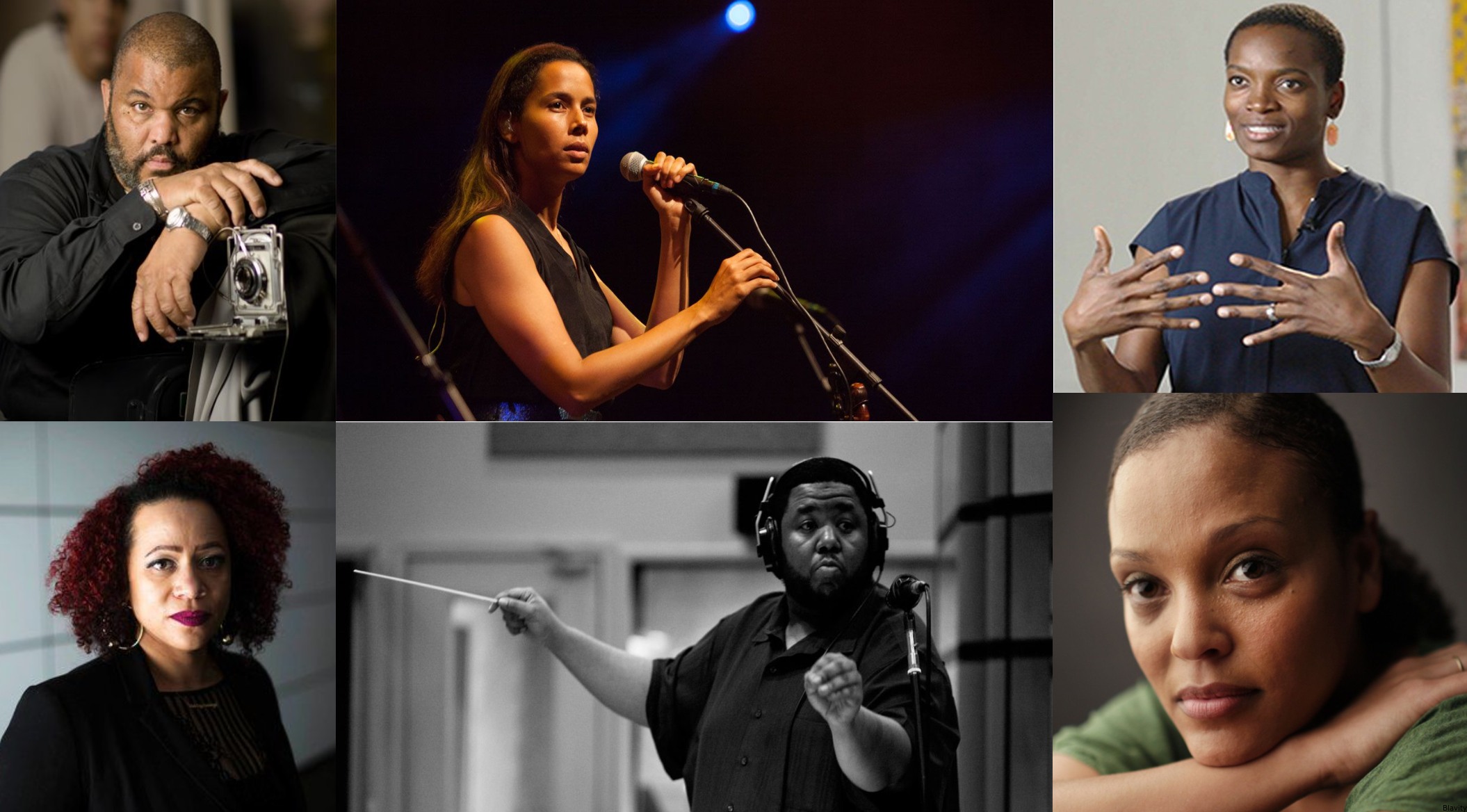
The John D. and Catherine T. MacArthur Foundation has announced the winners of this year’s fellowship, better known as the “genius” grant. 24 fellows were chosen, whose professions range immensely across the board. There are historians and musicians, computer scientists and social activists, writers, and architects.
What they all have in common is that each of the recipients has been selected for having “shown extraordinary originality and dedication in their creative pursuits and a marked capacity for self-direction” — and each will receive a $625,000 award from the foundation “as an investment in their potential,” paid out over five years with no strings attached. This year, there were six black recipients of the amazing award:
1. Njideka Akunyili Crosby, 34, painter living in Los Angeles
“Njideka Akunyili Crosby is visualizing the complexities of globalization and transnational identity in works that layer paint, photographic imagery, prints, and collage elements.”
2. Dawoud Bey, 63, photographer and educator living in Chicago
“Dawoud Bey is using an expansive approach that creates new spaces of engagement within cultural institutions, making them more meaningful to and representative of the communities in which they are situated.”

by Trey Magnum via shadowandact.com
A black superhero family drama from Michael B. Jordan and Charles D. King’s MACRO is coming to Netflix. The streaming giant has greenlit Raising Dion for a 10-episode, straight-to-series order. It is based on Dennis Liu‘s viral short film of the same name, which revolves around a black mother who discovers her young son has multiple and constantly changing abilities.
Jordan will executive produce and also appear in the series in a supporting capacity. Veteran showrunner Carol Barbee is on board and wrote the Netflix adaptation and will serve as showrunner and will executive produce. Liu will direct and executive produce MACRO’s Charles D. King, Kim Roth and Poppy Hanks are also executive producing along with Kenny Goodman and Michael Green. This is the first TV series order for MACRO.
The Netflix series will follow a woman named Nicole Reese, who raises her son Dion after the death of her husband Mark (Jordan). The normal dramas of raising a son as a single mom are amplified when Dion starts to manifest several magical, superhero-like abilities. Nicole must now keep her son’s gifts secret with the help of Mark’s best friend Pat, and protect Dion from antagonists out to exploit him while figuring out the origin of his abilities.
According to THR, the show, which first began development in 2016, was retooled and tapped a new showrunner in Barbee after the success of Eleven on Netflix’s Stranger Things, so the shows would not overlap. At the end of 2016 it got back on track and Jordan joined the project in early 2017. Casting started in February, but as of now, Jordan is the only one attached to appear.
The original Raising Dion short film is below. A comic book companion was also released.
To read full article, go to: Netflix orders black superhero family drama ‘Raising Dion,’ from Michael B. Jordan and MACRO