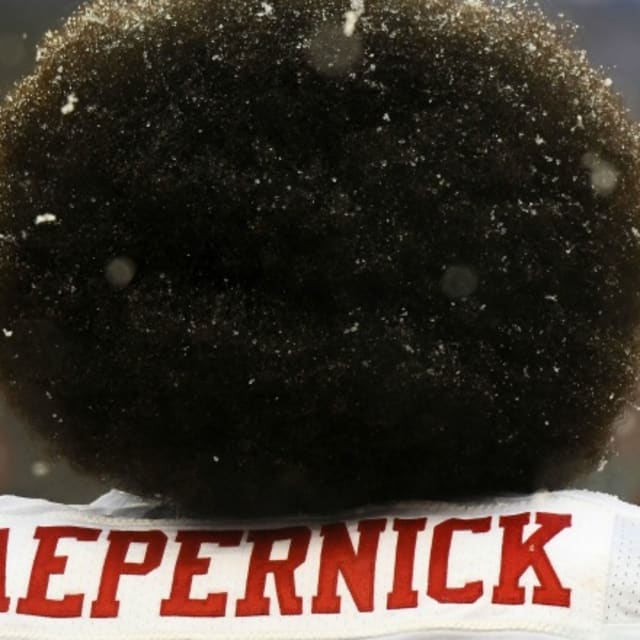
Hank Aaron (l); Colin Kaepernick (r) [via nydailynews.com]by Michelle R. Martinelli via ftw.usatoday.com
Halfway through the NFL preseason schedule, Colin Kaepernick is still unemployed. Despite teams like the Baltimore Ravens and Miami Dolphins recently shopping for another quarterback to add to their rosters, no one has elected to sign Kaepernick. A variety of sports figures have expressed their disappointment in NFL teams appearing to blackball the 29-year-old – from Mark Cuban to Dick Vitale to Johnny Manziel.
Add 83-year-old MLB legend Hank Aaron to the long list of Kaepernick supporters. During an interview with journalist Roland Martin posted to YouTube, Aaron said:
“I think he’s getting a raw deal. I’ve been watching pro ball for a long time, and I think that if you look at all the quarterbacks in the league right now, I think you have to say he is one, two, three, four. I don’t think anybody can do the things that he (does). So I just wish somebody would open up and give him a chance to do his thing and say, ‘Hey, he’s entitled to whatever he did, and let’s forget about it.’”
Last season while playing for the San Francisco 49ers, Kaepernick sat and kneeled during the national anthem, protesting racial injustice and oppression. Although Kaepernick isn’t on a roster, several players have demonstrated during the national anthem in their own ways during the preseason, including Michael Bennett, Derek Carr, Malcolm Jenkins and Chris Long.
When Martin asked Aaron if he wanted to see more NFL players stand with Kaepernick and his message, Aaron said:“I’d love to see some other players stand with him. I would love that. I think it would give him some incentive. I think it would help him. I think the thing that bothers me about this whole situation is the fact that he has gone to all these camps, I suppose, and nobody seems to think he stands a chance of being No. 1. Here’s a man, a young player that almost carried a team to a championship – to the Super Bowl. I remember that.”
Aaron also said he believes Kaepernick remaining unsigned is a decision made by team owners, rather than general managers. To see full video of Aaron’s remarks, watch below:
Nikki Giovanni (Image by Furious Flower Poetry Center / Flickr) via onbeing.org Nikki Giovanni was a revolutionary poet of the Black Arts Movement that nourished civil rights. She had a famous dialogue with James Baldwin in Paris in 1971. As a professor at Virginia Tech, she brought beauty and courage by the way of poetry after the shooting there.
Today, she is a self-proclaimed space freak and a delighted elder — an adored voice to hip-hop artists and the new forms of social change this generation is creating.
Check out Ms. Giovanni’s On Being Podcast from August 24, 2017 by clicking below:
[soundcloud url=”https://api.soundcloud.com/playlists/180494964″ params=”color=ff5500&auto_play=false&hide_related=false&show_comments=true&show_user=true&show_reposts=false&visual=true” width=”100%” height=”450″ iframe=”true” /] Source: Nikki Giovanni — Soul Food, Sex, and Space | On Being
A patient receives chemotherapy. (Simon Jarratt/Corbis/VCG / Getty Images) byChandelles R. Duster via nbcnews.com
Health care disparities among blacks and Latinos compared to whites have narrowed because of the Affordable Care Act, also known as Obamacare, according to a study published by The Commonwealth Fund Thursday. The report found that the number of blacks and Latinos without health care coverage dropped during the first two years of the ACA’s coverage expansion.
From 2013 and 2015, the uninsured rate among blacks between ages 19-64 dropped 9 percent, and dropped 12 percent among uninsured Latinos ages 19-64, the study showed. The rate of uninsured whites dropped 5 percent. The disparity among uninsured blacks and whites also narrowed by 4 percent and among Latinos and whites narrowed 7 percent. Dr. Pamela Riley, vice president of The Commonwealth Fund’s Delivery System Reform and a coauthor of the report, said although the study shows progress in health coverage for everyone, blacks and Latinos are still more likely than whites to not get the medical care they need. “If we are going to reduce these disparities, we must continue to focus on policies like expanding eligibility for Medicaid that will address our health care system’s historic inequities,” Riley said in a statement.
The analysis also found the number of uninsured Latino adults dropped 14 percent in states that expanded Medicaid coverage compared to 11 percent in states that did not. The number of uninsured black adults meanwhile fell 9 percent in states both with and without Medicaid expansion. And because of the decline in the number of uninsured, the number of adults ages 18 and older who reported skipping health care when they needed it because of high costs also declined.
After Senate Republicans failed to “repeal and replace” the current health care law, uncertainty looms around Obamacare’s future once Congress returns to Washington from recess. The Commonwealth Fund’s President Dr. David Blumenthal said improving the ACA will continue to help minorities get access to health care. To read full article, go to: Health Disparities Narrowed for Blacks, Latinos Under Obamacare, Study Shows – NBC News
Def Comedy Jam 25 (photos via thegrio.com) via thegrio.com Netflix announced on Thursday that it will produce “Def Comedy Jam 25” to mark the 25th anniversary of the comedy show, to air this fall. “Def Comedy Jam” originally ran from 1992 to 1996 before being revived in 2006. The show, which was produced by Russell Simmons, helped to launch the careers of the likes of Martin Lawrence, Cedric the Entertainer and Sheryl Underwood.
The lineup of performers for the special thus far include: Lawrence, Underwood, Bill Bellamy, Cedric the Entertainer, Dave Chappelle, Mike Epps, Adele Givens, Eddie Griffin, Tiffany Haddish, Kevin Hart, Steve Harvey, D.L. Hughley, Kid Capri, Tracy Morgan, Craig Robinson, JB Smoove, Sommore, Joe Torry and Katt Williams. To read original article, go to: Netflix announces ‘Def Comedy Jam 25’ to mark 25th anniversary | theGrio
(Image via USA TODAY Sports/Mike DiNovo) by Jose Martinez via complex.com
Hundreds of people gathered outside NFL headquarters in New York City on Wednesday to show their support for quarterback Colin Kaepernick. With the start of the NFL season nearly two weeks away, Kaepernick remains a free agent, and it’s become evident that his current status has more to do with his national anthem protest last season than his skills on the football field.
At the “United We Stand” rally, the large crowd held signs while making sure their voices were heard and their presence was felt. Even Kaepernick’s fraternity, Kappa Alpha Psi, came out to support their brother. Derrick Johnson, NAACP interim president and CEO, has sent a letter to NFL commissioner Roger Goodell, requesting a meeting to discuss “the issue of First Amendment rights and free speech issues surrounding players” in the league. Johnson insinuates that Kaepernick’s inability to sign with a team has to do with being blackballed by the NFL after taking a stand against racial injustice.
https://twitter.com/yourrightscamp/status/900482342216622080?ref_src=twsrc%5Etfw&ref_url=http%3A%2F%2Fwww.complex.com%2Fsports%2F2017%2F08%2Fpeople-gather-outside-nfl-headquarters-to-show-support-for-colin-kaepernick
“As outlined in your office’s public statement, this act of dissent is well within the National Football League’s stated bylaws. Yet, as the NFL season quickly approaches, Mr. Kaepernick has spent an unprecedented amount of time as a free agent, and it is becoming increasingly apparent that this is no sheer coincidence,” Johnson wrote. “No player should be victimized and discriminated against because of his exercise of free speech—to do so is in violation of his rights under the Constitution and the NFL’s own regulations.” To see full article, go to: People Gather Outside NFL Headquarters to Show Support for Colin Kaepernick | Complex
Morgan Freeman (photo via variety.com REX/SHUTTERSTOCK) by Dave McNary via Variety.com Morgan Freeman has been named the 54th recipient of the SAG Life Achievement Award for career achievement and humanitarian accomplishment. Freeman will be presented the accolade at the 24th Annual Screen Actors Guild Awards on Jan. 21 at the Shrine Auditorium in Los Angeles. The award is given annually to an actor who fosters the “finest ideals of the acting profession.”
Freeman has won a Screen Actors Guild Award, an Academy Award, HFPA’s Cecil B. DeMille Award, an AFI Lifetime Achievement Award, seven Image Awards, a Silver Berlin Bear and a Kennedy Center Honor. SAG-AFTRA made the announcement Tuesday. “I am thrilled to announce Morgan Freeman as this year’s recipient of the SAG Life Achievement Award,” said SAG-AFTRA President Gabrielle Carteris. “Some actors spend their entire careers waiting for the perfect role. Morgan showed us that true perfection is what a performer brings to the part. He is innovative, fearless and completely unbound by expectations… It has been a privilege to see his genius at work.”
Freeman won an Academy Award in 2005 for Best Supporting Actor for “Million Dollar Baby.” He was nominated for Oscars for “Street Smart” (1987), “Driving Miss Daisy” (1989), “The Shawshank Redemption” (1994) and “Invictus” (2009). He also won a SAG Award for “Million Dollar Baby.”
He has nearly 100 feature film credits including “The Dark Knight,” “The Bucket List,” “Glory,” “Lean on Me,” “Se7en,” “Amistad,” “Bruce Almighty,” and “Along Came a Spider.” Recent credits include “Going In Style,” “Ben-Hur,” “Now You See Me 2” and “London Has Fallen.” Freeman’s upcoming films include “Villa Capri” and Disney’s “The Nutcracker and the Four Realms.” To read full article, go to: Morgan Freeman Wins SAG Life Achievement Award | Variety
(LA Johnson/npr.org) by Julie Depenbrock via npr.org
An Arizona law banning ethnic studies violated students’ constitutional rights, a federal judge said Tuesday. His ruling made clear that the state showed discriminatory intent when it essentially shut down a Mexican-American studies program at Tucson Unified School District. “Both enactment and enforcement were motivated by racial animus,” federal Judge A. Wallace Tashima said in the ruling.
With this news, a portion of the law, prohibiting classes designed for students of certain ethnic groups, has been struck down, but the federal judge has yet to issue a final judgment and redress for the violation.Despite this decade-long debate in Arizona, ethnic studies programs have grown in popularity throughout the country. To read more, go to: Federal Judge Finds Racism Behind Arizona Law Banning Ethnic Studies : NPR Ed : NPR
(photo via ftw.usatoday.com) by Andrew Joseph via ftw.usatoday.com Seattle Seahawks defensive end Michael Bennett sat for the national anthem during the Seahawks’ first two preseason games — something he says he’ll continue to do for the regular season — and he said that it would take a white player joining the national anthem protests to really change the conversation.
On Monday, Cleveland Browns tight end Seth DeValve listened. DeValve (No. 87, above) joined teammatesJamie Collins, Christian Kirksey, running backs Duke Johnson and Isaiah Crowell, wide receivers Kenny Britt and Ricardo Louis, safety Jabrill Peppers and cornerback Jamar Taylor in taking a knee for the anthem before a preseason game against the Giants. DeValve is the first white player to kneel for the anthem since Colin Kaepernick started his protest last season.
While Kaepernick remains without a team, Bennett and many other NFL players have continued that protest. On Wednesday, Bennett said that it would take a white player kneeling to amplify the conversation about social injustice in the U.S.
Bennett said via ESPN:
“It would take a white player to really get things changed because when somebody from the other side understands and they step up and they speak up about it … it would change the whole conversation. Because when you bring somebody who doesn’t have to be a part of [the] conversation making himself vulnerable in front of it, I think when that happens, things will really take a jump.”
The president of the University of Texas at Austin has ordered the immediate removal of statues of Robert E. Lee and three other Confederate-era figures — Albert Sidney Johnston, John Reagan and James Stephen Hogg — from a main area of campus.
President Greg Fenves announced the statues’ fate Sunday night, and the removals should be complete by mid-morning Monday. A university spokesman says the area has been blocked off. Lee and Johnston were Confederate generals, Reagan was a Confederate postmaster and Hogg was the first native-born governor of Texas and the son of a Confederate general.
In a letter to the university community, Fenves connected the events with the decision to remove the statues now: “[T]he horrific displays of hatred at the University of Virginia and in Charlottesville shocked and saddened the nation. These events make it clear, now more than ever, that Confederate monuments have become symbols of modern white supremacy and neo-Nazism.” …”The University of Texas at Austin has a duty to preserve and study history. But our duty also compels us to acknowledge that those parts of our history that run counter to the university’s core values, the values of our state and the enduring values of our nation do not belong on pedestals in the heart of the Forty Acres.”
“We do not choose our history, but we choose what we honor and celebrate on our campus.”The statues of Lee, Johnston and Reagan will be added to the collection at the university’s Dolph Briscoe Center for American History for “scholarly study,” Fenves wrote. The Hogg statue will be considered for relocation elsewhere on campus. In 2015, the university removed a statue of Confederacy President Jefferson Davis.
On Saturday, Duke University announced that it had removed a statue of Gen. Lee that was in the entry to the large chapel on its campus. To read full article, go to: Confederate Statues Come Down At The University Of Texas : The Two-Way : NPR
Investigative Journalist Shaun King
A snippet and the link to this brave man’s work is below. Please read and follow this groundbreaking series via medium.com as well as Shaun King (Facebook, Twitter). He is doing so much what needs to be done to root out injustice not only in NYC, but all across the country:
What I’m about to tell you is the most painful, traumatic, outrageous, outlandish, over-the-top story of government sanctioned police brutality, wrongful imprisonment, wrongful convictions, forced testimony, widespread corruption, money, lots of money, and deep, deep, deep soul-snatching psychological abuse in modern American history. I would not have believed it had I not seen it all for myself. The rabbit hole I am about to take you down is deep and twisted. It should lead to the termination of a whole host of officials. Many should be arrested and a comprehensive independent investigation should begin immediately.
I receive hundreds of personal emails about injustice in America every single day. In mid-July, dozens of those emails were about a Bronx teenager named Pedro Hernandez. People all over the country had seen reports from Sarah Wallace of NBC New York or James Ford of Pix 11 on how Hernandez, who was jailed at Rikers Island, was running out of time to be released in time to start college. Hernandez had won awards at Rikers for his leadership and academic performance, and had also been granted a scholarship from the Posse Foundation to enter college this fall. Offered a plea deal from the Bronx DA’s Office to be released for time served, Hernandez did what few people in his position would do — he turned down the deal. Accused of shooting Shaun Nardoni, a neighborhood teenager, in the leg on September 1st, 2015, Hernandez was offered a ticket out of Rikers in exchange for admitting he shot Nardoni. The District Attorney even sweetened the pot and pledged to expunge his record in five years if he met all of the terms of his probation. Hernandez still refused to take the deal — continuing to pledge that he was completely innocent and would rather take his chances with a jury before admitting to something he didn’t do.
For nearly a week, people emailed me about Pedro’s case before I finally clicked on the link to see what it was all about. Tory Russell, an activist and organizer from St. Louis, who I’d come to know fr
om Ferguson, sent me a direct message on Twitter asking me if I could read the story and support Pedro somehow. I was on vacation with my family and it still took me another three days to finally read the story. I was hooked, but I had questions. As I Googled Pedro’s name and case, I saw several local reports that stated he had been wrongfully arrested and harassed by the NYPD for years. A guard at another facility was actually arrested and charged with criminal assault, endangering the welfare of a child, criminal obstruction of breathing and blood circulation, and harassment after being caught on film brutally beating and choking Pedro. Eight different eyewitnesses had all come forward to state that Pedro was not the shooter. Many even went so far as to identify the actual shooter. Why then, did Pedro remain behind bars? Why did it seem like the NYPD had it out for him? And how could the Bronx DA simultaneously believe that Pedro was safe enough to set free if he took the plea, but so dangerous, that if he didn’t, his bail would be set at an outrageous $250,000 with a stipulation that he not pay the typical 10%, but pay all $250,000 — effectively ensuring that he’d never get out on bail. That Pedro Hernandez, with the entire deck stacked against him, still refused to take a plea, hooked me.
As I reached out to Pedro’s family, I was immediately struck by something peculiar. I’ve written nearly 1,000 stories about police brutality and misconduct and have interviewed hundreds of families suffering through the consequences of those things. Almost every single one of those families, particularly when they are still in a stage of grief or conflict, without fail, want to speak exclusively about their very specific case. Pedro’s family was different. They immediately wanted me to know that Pedro was not alone, but that he was just one of hundreds of victims whose lives had been turned upside down by officers from the 42nd precinct in the Bronx who were working in close concert with the Bronx District Attorney’s Office. The accusations were so sweeping and broad that I wasn’t sure how to process them.